bali is great palce i ever come...all people nice and good....that's make me 100% i have come back here....terimakasih (she say it with smiling)... :)
|
|
|
|---|
Kamis, 28 Oktober 2010
Bali is magical
As probably the most famous island in Indonesia, Bali blends spectacular mountain scenery and beautiful beaches with warm and friendly people, a vibrant culture and out of this world resorts.
Travel & Leisure Magazine has awarded Bali the World’s Best Island in 2009, while the Lonely Planet’s Best of Travel 2010 ranked Bali second place among the world’s Top Regions.
Free bali here
Selasa, 26 Oktober 2010
Bali Safari and Marine Park
Bali Safari and Marine Park is established by Taman Safari Indonesia who operate a successful safari park in Bogor, West Java, the Bali facility is lauded as the Company’s flagship park and will eventually employ a workforce of 400 charged with caring for the animals and serving the thousands of visitors expected to visit Bali Safari each day.
Designed by a leading U.S. zoo architect, guests will board special safari busses for drives passing through different areas of the park serving as home to a number of animals, including: rare white Bengali tigers, Sumatran tigers, hippopotami, lions, zebras, elephants, wildebeest, camels, alligators, bears and sundry primates – all roaming in large, near-natural settings.
Reached by the near Professor I.B, Mantra highway, the park is located on Lebih Beach, just minutes from Sanur.
Facilities
Bali Safari and Marine Park has many
facilities, including:
•Animals in natural surroundings.
•The exciting recreation area.
•Fun Zone.
•The amazing Bali Theatre.
•Cottages and Bungalows.
•Varied and delicious foods at the beautiful scenic restaurants.
Come and have a one-of-a-kind experience with a Balinese cultural influence, supported by the warm hospitality of the island’s people.
Designed by a leading U.S. zoo architect, guests will board special safari busses for drives passing through different areas of the park serving as home to a number of animals, including: rare white Bengali tigers, Sumatran tigers, hippopotami, lions, zebras, elephants, wildebeest, camels, alligators, bears and sundry primates – all roaming in large, near-natural settings.
Reached by the near Professor I.B, Mantra highway, the park is located on Lebih Beach, just minutes from Sanur.
Facilities
Bali Safari and Marine Park has many
facilities, including:
•Animals in natural surroundings.
•The exciting recreation area.
•Fun Zone.
•The amazing Bali Theatre.
•Cottages and Bungalows.
•Varied and delicious foods at the beautiful scenic restaurants.
Come and have a one-of-a-kind experience with a Balinese cultural influence, supported by the warm hospitality of the island’s people.
dreamland Beach
Forget in moment Kuta, Sanur, and or Nusa Dua. Enjoying Bali only by sand sunning in the coasts not be prestigious anymore. Nowadays, time for you enjoying more challenging exotic and exclusive vacation. Because the coasts only known by a few tourists. The information even also by mouth to mouth. You will not find in reference or travel. Even so maybe its not too much and can be calculated by finger.
Dreamland is on the south side of Bali, about 30 to 40 minute
s from Kuta. There are 2 alternative ways to go to Dreamland. You can either go through the Jimbaran Bay area or pass through the Dwipayana University (a well-known public university in Bali); both ways are easy to follow. If you do get lost, ask for directions to Garuda Wisnu Kencana (GWK). It’s a famous cultural park located in Bukit Unggasan, Jimbaran. Here you can find a 75 meter-high and 60-meter wide figure of god Visnu, one of the Trimurti symbols in Hinduism. The status is made by I Nyoman Nuarta, and is now still unfinished. When it is done, it will be taller than the Statue of Liberty in New York!
About 15 minutes from GWK, you will find a big statue of Garuda (the symbol of Indonesia), on the right side of the road. That means you’re just a stone throw’s away from Dreamland Beach. Dreamland Beach is located on a big-deserted property, a failed Pecatu Graha development. You will probably have to pay about Rp 5000 for the entry. When you get to the end of the road, you will be on top of a cliff, with the big blue ocean’s sky in front of you. Look down! That’s Dreamland Beach…
You have to walk a little then down a path of stairs to reach the beach.. Once on the sand, you will find rented umbrellas and beach benches facing the beach. You can also order food and drinks from the local traditional cafés available all around the beach. The cafes might seem common and usual, but many of them actually serve European dishes which is out of the ordinary for this setting. Planning to spend the night? Some of the local cafes offer humble accommodations at a reasonable price (ranged between Rp 50,000 to Rp 200,000 per night). In the evening, enjoy the sunset whilst several tourists build a campfire on the beach, or just play a light game of beach ball. As for me, I prefer swimming offshore and enjoy the sunset from there.
There are not many activities to be done here at night. The electricity is turned off after 10 pm and thus candles are lit to chase away the deep darkness of the night. After having dinner, the best thing you can do is to read a book or have a draft of cold beer. Otherwise, you can go upstairs to where most of the rooms are and enjoy the scenery. The moon’s reflection dancing in a flurry of lights on the ocean’s surface is simply breathtaking. During the peak season (July and December), some of the rooms on this floor will be more packed so at least you are not alone and will have company to chat with along with your own group of friends. It is always interesting meeting other travelers and sharing experiences. When you finally feel like sleeping, go back to your room and snuggle under the blanket. The lullaby of tides breaking on the shore is such a peaceful sound to sleep to. Being in Dreamland is like being in a dream you wish you will never wake up from.
Beautiful Ubud For Your Bali Vacation
What is it about Ubud that one should visit this beautiful village? Because Ubud has much to offer; from its stunning panorama of Ayung River valley and the terraces rice filed, its most talented artist, its typical traditional market and myriad of shops that line the road is a heaven for shopping, its undying culture, its serene environs and plentiful of nice small hotels and restaurants and many more.
Ubud has no great beaches to speak of, no mountain lakes, and no grand hotels. Yet it has the richness of soil and it is the center of Bali’s art and culture. If you don’t stay in Ubud, or you don’t have much time during your Bali Holiday, a visit is worth because it would offer you a memorable stay in Bali.
Driving out of bustling Denpasar, the tranquil green of rice paddies contrast sharply with the boisterous sounds of the city. Palm-leaf carvings of Dewi Sri (the Rice Goddess) guards over the crops, and small thatch huts dot the rice fields, giving shade to those who work them. Temples and small shrines can be seen along the way, women lay out offerings of flowers, rice, incense and holy water to placate evils spirits and please the good one. Even with the great influx of tourism, village life basically goes on the same. Almost every village on the way up to Ubud specializes in some kind of art form. You can stop off and see the artisans at work in their studios.
Many places near Ubud make beautiful side trips. Morning walk through the villages lead to out-of-the-way retreats. The route to Tegalalang offer beautiful views of terraces rice field and myriad of art studios, Mas, Penestanan and Peliatan, the centers of wood carving and painting, Sayan offer a stunning panorama of Ayung River valley and still home to spectacular view of gorges and palms and rice fields. Campuhan , the place where three rivers meet – a sacred site. There is a very beautiful temple called Pura Gunung Lebah is worth a visit.
To the north is Petulu village is known for many things but the most spectacular is the kokokan or white herons. Every morning at dawn and the afternoon around three or four o’clock, you can see them circling the trees in droves.
To the south a short walk you will arrive at Monkey Forest. To visit it, one must by a ticket. There are hundreds of tame monkeys and a temple stands in the middle of the forest. In the center of town the interesting places to see are the Puri (the court of palace of former kings), here every Sunday morning at 10 o’clock dozen of young girls study traditional Balinese dance. Ubud main market just opposite the Puri offer varieties of merchandises; Produce, dry goods, linens, T-shirts, paintings, wood carvings, even traveling medicine men appear here. Closed to market you can visit Puri Lukisan (Museum of Paintings). Established in 1954, it is dedicated to showing the works of local painters. It is the excellent place to get an overview of the stylistic differences between artists.
Ubud is a picturesque township and visitors have been attracted by its charm and beauty for decades. If shopping is your interest, Ubud has a myriad of shops which line the road to Monkey Forest and the Museum Puri Lukisan. Don’t forget to bargain!!! If art is your interest, in Ubud, Mas and Peliatan, one can study dance, music, painting or a number of other art forms. The best way to meet a teacher is to find a style that appeal to you (by going to galleries and watching performances) and than approach the artist directly about lessons.
So Ubud has many attractive objects can be seen for your Bali Vacation. And do not hesitate to choose beautiful Bali for your holiday. Bali is a small, beautiful island in Indonesia, the ultimate tourist destination in Asia.
Ubud has no great beaches to speak of, no mountain lakes, and no grand hotels. Yet it has the richness of soil and it is the center of Bali’s art and culture. If you don’t stay in Ubud, or you don’t have much time during your Bali Holiday, a visit is worth because it would offer you a memorable stay in Bali.
Driving out of bustling Denpasar, the tranquil green of rice paddies contrast sharply with the boisterous sounds of the city. Palm-leaf carvings of Dewi Sri (the Rice Goddess) guards over the crops, and small thatch huts dot the rice fields, giving shade to those who work them. Temples and small shrines can be seen along the way, women lay out offerings of flowers, rice, incense and holy water to placate evils spirits and please the good one. Even with the great influx of tourism, village life basically goes on the same. Almost every village on the way up to Ubud specializes in some kind of art form. You can stop off and see the artisans at work in their studios.
Many places near Ubud make beautiful side trips. Morning walk through the villages lead to out-of-the-way retreats. The route to Tegalalang offer beautiful views of terraces rice field and myriad of art studios, Mas, Penestanan and Peliatan, the centers of wood carving and painting, Sayan offer a stunning panorama of Ayung River valley and still home to spectacular view of gorges and palms and rice fields. Campuhan , the place where three rivers meet – a sacred site. There is a very beautiful temple called Pura Gunung Lebah is worth a visit.
To the north is Petulu village is known for many things but the most spectacular is the kokokan or white herons. Every morning at dawn and the afternoon around three or four o’clock, you can see them circling the trees in droves.
To the south a short walk you will arrive at Monkey Forest. To visit it, one must by a ticket. There are hundreds of tame monkeys and a temple stands in the middle of the forest. In the center of town the interesting places to see are the Puri (the court of palace of former kings), here every Sunday morning at 10 o’clock dozen of young girls study traditional Balinese dance. Ubud main market just opposite the Puri offer varieties of merchandises; Produce, dry goods, linens, T-shirts, paintings, wood carvings, even traveling medicine men appear here. Closed to market you can visit Puri Lukisan (Museum of Paintings). Established in 1954, it is dedicated to showing the works of local painters. It is the excellent place to get an overview of the stylistic differences between artists.
Ubud is a picturesque township and visitors have been attracted by its charm and beauty for decades. If shopping is your interest, Ubud has a myriad of shops which line the road to Monkey Forest and the Museum Puri Lukisan. Don’t forget to bargain!!! If art is your interest, in Ubud, Mas and Peliatan, one can study dance, music, painting or a number of other art forms. The best way to meet a teacher is to find a style that appeal to you (by going to galleries and watching performances) and than approach the artist directly about lessons.
So Ubud has many attractive objects can be seen for your Bali Vacation. And do not hesitate to choose beautiful Bali for your holiday. Bali is a small, beautiful island in Indonesia, the ultimate tourist destination in Asia.
Tirta Gangga
Tirta Gangga is situated at Ababi village, Abang District. It is about 83 km from Denpasar and 6 km from Amlapura to the north.
Tirta Gangga water garden was built in 1948 by the King of Karangasem, Anak Agung Anglurah Ketut Karangasem. This water garden was constructed in a very unique architecture of Balinese and Chinese styles.
Tirta Gangga Water Garden scratches on a 1,2 Hectare area, which consists of three complexes. The first complex lies on the lowest level of this area, where we can find two ponds and a water tower. The second complex in the middle level is the location where we can find swimming pools; while in the third part, which is the main complex, we can find the rest house of the King.
Before the construction of the water garden, there was a big spring water in this area. Therefore people surrounding the area called this place "embukan" which means spring water.
The spring water was then functioned to fulfil the people's need of water and also for the "purification" of the Gods (Ida Betara). For this case, the spring water is recognised to be holy and sacred.
The religious to construct this tranquil water garden for his rest house and also for the people's function and the cool climate of this area, plus the fascinating view around, inspired the kingleisure and pleasure.
Tirta Gangga water garden was built in 1948 by the King of Karangasem, Anak Agung Anglurah Ketut Karangasem. This water garden was constructed in a very unique architecture of Balinese and Chinese styles.
Tirta Gangga Water Garden scratches on a 1,2 Hectare area, which consists of three complexes. The first complex lies on the lowest level of this area, where we can find two ponds and a water tower. The second complex in the middle level is the location where we can find swimming pools; while in the third part, which is the main complex, we can find the rest house of the King.
Before the construction of the water garden, there was a big spring water in this area. Therefore people surrounding the area called this place "embukan" which means spring water.
The spring water was then functioned to fulfil the people's need of water and also for the "purification" of the Gods (Ida Betara). For this case, the spring water is recognised to be holy and sacred.
The religious to construct this tranquil water garden for his rest house and also for the people's function and the cool climate of this area, plus the fascinating view around, inspired the kingleisure and pleasure.
Tanjung Benoa
Located north of Nusa Dua, this is a beautiful white sand beach area where visitors can enjoy many types of water recreation and sports such as snorkeling, parasailing, diving, boating, sailing, glass bottom boating and more. This area is an extension of Nusa Dua Resort, with easy access to its luxurious hotels and other tourism facilities.
The beach is renowned for its calm clear waters, ideal for swimming and snorkelling, whilst the outer reefs are great for surfing. Being fairly isolated and some 30 to 40 minutes drive to Kuta, the region is removed from the frantic pace of Kuta and subsequently free from the crowds.
Whilst the atmosphere is relaxed, you will not be short of things to do and the Galleria shopping complex will keep you occupied for hours.
Once upon a time, the Balinese giant and master builder Kebo Iwa decided that the Tanjung Benoa marshes should be transformed into rice fields, so he went to the Bukit and picked up two scoops of earth. While shouldering them along the coast, his pole broke, dropping the earth into the sea. Two islets appeared: the "Nusa Dua."
The marshes were never to become rice fields the bay remained a bay with a long cape, Tanjung Benoa, jutting into it. Nevertheless, Kebo Iwa, who created the area, is now engaged in a new venture - luxury hotel development.
Making Nusa Dua into a tourist paradise was a consciously implemented government policy, designed with the help of the World Bank. Two main concepts underlay the project: to develop an up-market tourist resort, beautiful, secure, easy of access, with the most modern facilities, while keeping the disruptive impact on the local environment as low as possible.
The beach is renowned for its calm clear waters, ideal for swimming and snorkelling, whilst the outer reefs are great for surfing. Being fairly isolated and some 30 to 40 minutes drive to Kuta, the region is removed from the frantic pace of Kuta and subsequently free from the crowds.
Whilst the atmosphere is relaxed, you will not be short of things to do and the Galleria shopping complex will keep you occupied for hours.
Once upon a time, the Balinese giant and master builder Kebo Iwa decided that the Tanjung Benoa marshes should be transformed into rice fields, so he went to the Bukit and picked up two scoops of earth. While shouldering them along the coast, his pole broke, dropping the earth into the sea. Two islets appeared: the "Nusa Dua."
The marshes were never to become rice fields the bay remained a bay with a long cape, Tanjung Benoa, jutting into it. Nevertheless, Kebo Iwa, who created the area, is now engaged in a new venture - luxury hotel development.
Making Nusa Dua into a tourist paradise was a consciously implemented government policy, designed with the help of the World Bank. Two main concepts underlay the project: to develop an up-market tourist resort, beautiful, secure, easy of access, with the most modern facilities, while keeping the disruptive impact on the local environment as low as possible.
Nusa Penida
Once known as the Siberia of Bali, Nusa Penida was formerly a penitentiary island of banishment for criminals, undesirables, and political agitators fleeing the harsh and unyielding reign of the Gelgel dynasty.
The people have their own 'adat', dances, puppetry, weaving arts, and architecture. The dour and cheerless people of the central plateau live in austere one-room huts built of jagged limestone blocks, surrounded by rustic stables, storage sheds, the family shrine (sanggah), and terraced dry fields.
Most festivals and religious events are devoted to appeasing, deceiving, or exorcising the black-faced demon-king Jero Gede Mecaling and his white-skinned wife Jero Luh. Personified in giant puppets (barong landung), these terrifying deities dance and strut through village streets at festival times. Another popular exorcist dance is sanghyang jaran, held during times of catastrophe in the Sakti area of west Nusa Penida.
Dance costumes, body ornaments, and gestures are less elaborate than on Bali. In Cemulik (near Sakti) and Pelilit (in the southeast), the 'gandrung' is performed on Purnama, Tilem, and Kajeng Kliwon. In this dance two adolescent boys dress as women. The group 'baris gede' dance is staged during 'odalan' at Batunuggul, and the archaic 'baris pati' is performed in graveyards during cremations, and the 'baris jangkang' is occasionally trotted out to welcome officials to Sekartaji.
Nusa Penida's most lucrative export is edible seaweed, grown in submarine pens along the northwest and northeast coasts, off Nusa Lembongan and in the channel between Nusa Lembongan and Nusa Ceningan. After drying on the beach and along the roads the seaweed is exported to Hong Kong for processing into agar, a thickening agent used in cooking, and carrageenan used in cosmetics and in crackers, sauces, condiments, and other food products.
A small-scale fishing industry catches mostly sardines and Bali's largest and most succulent lobsters. On the south coast fishermen descend paths to the sea, where they fish from platforms protruding from the sheer cliff walls.
Road from Batumadeg takes you across a plateau for seven km to Batukandik, which possesses 'male' and 'female' shrines. This unique temple also has a prehistoric stone altar, a heavily eroded woman with enormous breasts supports a stone throne on her head, two roosters standing on her shoulders. The Holy Forest of Sahab hides a temple, said to be the exit of a mythical tunnel connecting Bali with Nusa Penida. The hole apparently starts in Pejeng.
Water Sport
As a dive and snorkeling locale, Nusa Penida is at least as spectacular as Bunaken in North Sulawesi. But it's a long and expensive ride, and, once there, cold, strong, unpredictable swells and currents up to four or more knots make conditions challenging and even hazardous. Not the place for beginners.
No dive operators exist on Nusa Penida so finding a well-organized dive outfit on Bali, a knowledgeable guide with plenty of experience in the area, a reliable craft, skilled boatmen, and a good engine are all necessities. The best dive sites, in the channel between Nusa Penida and Nusa Ceningan, are close together and you can move to alternate locations as conditions dictate.
Two of the most convenient sites lie off the 'dermaga' east of Toyapekeh. Fish life, particularly pelagic, tuna, jacks, and reef sharks are common; manta rays collect on the southwest end of the island. The variety of coral along the drop-offs and steep slopes is incredibly rich, but because of deep upwelling the water can be uncomfortably cold, dropping to below 19° C during the Balinese winter. Visibility, up to 15 meters, is quite good.
Crafts
Nusa Penida's weaving style is called 'tenun Bali ikat cagcag', or by the local names 'cepuk' or 'capuk'. Goods are woven by hand on backstrap looms in the plateau villages of Tanglad and Karang. Distinctive blood-red, brown, and yellow traditional cloths with plaid and rough checkered designs are worn by participants in life-cycle ceremonies. The per meter price depends on the quality of the material and the intricacy of the design.
Getting There
Kusamba is a small Muslim fishing village on the southeast coast of Bali, a six-km bemo ride east of Klungkung. Turn in at Jalan Pasir Putih about 1.5 km east of the town of Kusamba and walk 500 meters to Banjar bias, where you'll see small, bullish outboard-powered outriggers taking on cargo. Boats usually leave twice daily, but only when there are enough passengers.
Another departure point, preferred by Nusa Penida residents, is from Kampung Kusamba about 100 meters from the 'pasar'. These motorized outriggers carry passengers to, among other places, Toyapakeh on Nusa Penida. Make sure you're on the right boat. The 10-km passage takes 45 minutes to one hour, depending on the wind and the choppiness of the water. When you arrive in Toyapakeh, there are frequent bemo to Sampalan. Boats must return to Kusamba by 1400.
From Padangbai the charge is the same. Buy your ticket in the 'loket' to the north of the main Lombok ferry ticket office. The first express ferry departs at around 0630, but you have to wait for it to fill up. And you might wait awhile, what with its 45-passenger capacity.
The crossing takes just 30 minutes, docking at Buyuk just east of Toyapakeh. From there you can hop a bemo east into Sampalan. From Jungut Batu on the northwest coast of the neighboring island of Nusa Lembongan, small 'jukung motor' shoots over to Nusa Penida (45 minutes). Landing at the charming fishing village of Toyapakeh.
'Perahu' sail from Sanur to Toyapakeh (25 km, 1.25 hours) very early in the morning. Check out the day cruises offered by Bali International Yacht Club, tel. 62361-288391, in Sanur, Bali Intan Tours and Travel, tel. 62361-752005 or 752985 in Tuban, and many other outfits that visit the south coast of Nusa Penida. The charge includes free transport to the boat, drinks, packed lunch or Indonesian buffet, and fishing and snorkeling equipment.
Getting Around
Roads cover the island. Good roads run from Toyapakeh to Sampalan and on to Karangsari, and from Toyapekeh to Klumpu. The roads from Klumpu to Batumadeg, Tanglad, and Pejukutan are winding and bumpy but asphalted and traversable. Because of the island's rocky, undulating topography, only motorcycles, trucks, or tough canopied bemo can manage the bumpy, dusty roads of the outlying areas.
Bemo run irregularly between the main villages, connecting north coast towns and inland settlements. From Sampalan, 'bemo' begin carrying passengers out to the villages early in the morning, but by the afternoon the terminal is all but empty.
The best way to get around quickly is by motorcycle. As soon as you get off the boat at Buyuk or wander into the Sampalan terminal you'll be approached by motorcycle owners or drivers. You can either drive or be driven. It's cheaper to drive yourself, though the drivers know all the best places, can introduce you to people, and speak better Indonesian.
Expect a per diem price reduction if you take the motorbike for more than a day. Or wait a few days to meet someone, and convince a newfound local friend to drive you around for free (give a 'donation' to his younger siblings afterwards). Make sure your rental agreement makes it clear who pays for gas and oil.
Try to negotiate a free drop-off at your embarkation point back to Bali or Nusa Lembongan. Two good, cautious drivers are recommended: Nyoman Soma Arsana, who can be contacted by telephone through the Kantor Camat (tel. 62366-231.885), and Made Latoni, at Banjar Sental Kawan, Desa Ped.
Getting Away
Take boats to Padangbai (30 minutes) and Sanur (1.25 hours) from Buyuk, one km east of Toyapakeh. Get there by 0700 to buy your ticket at the Departemen Perhubungan office near the pier. Each boat holds about 30 people. If there are enough passengers, a boat sometimes leaves for Padangbai in the afternoon.
From Mentigi Harbor, one km west of Sampalan, hire boats to Banjarbias, then a bemo into Kusamba where other bemo pass by to Amlapura or Klungkung. The Balinese operate an organized transport cartel that fixes all fares to and from Bali-and there's really no way around it if your skin is white. To their credit, most boats offer life-jackets, hard wooden benches, and double 85 hp outboards.
The people have their own 'adat', dances, puppetry, weaving arts, and architecture. The dour and cheerless people of the central plateau live in austere one-room huts built of jagged limestone blocks, surrounded by rustic stables, storage sheds, the family shrine (sanggah), and terraced dry fields.
Most festivals and religious events are devoted to appeasing, deceiving, or exorcising the black-faced demon-king Jero Gede Mecaling and his white-skinned wife Jero Luh. Personified in giant puppets (barong landung), these terrifying deities dance and strut through village streets at festival times. Another popular exorcist dance is sanghyang jaran, held during times of catastrophe in the Sakti area of west Nusa Penida.
Dance costumes, body ornaments, and gestures are less elaborate than on Bali. In Cemulik (near Sakti) and Pelilit (in the southeast), the 'gandrung' is performed on Purnama, Tilem, and Kajeng Kliwon. In this dance two adolescent boys dress as women. The group 'baris gede' dance is staged during 'odalan' at Batunuggul, and the archaic 'baris pati' is performed in graveyards during cremations, and the 'baris jangkang' is occasionally trotted out to welcome officials to Sekartaji.
Nusa Penida's most lucrative export is edible seaweed, grown in submarine pens along the northwest and northeast coasts, off Nusa Lembongan and in the channel between Nusa Lembongan and Nusa Ceningan. After drying on the beach and along the roads the seaweed is exported to Hong Kong for processing into agar, a thickening agent used in cooking, and carrageenan used in cosmetics and in crackers, sauces, condiments, and other food products.
A small-scale fishing industry catches mostly sardines and Bali's largest and most succulent lobsters. On the south coast fishermen descend paths to the sea, where they fish from platforms protruding from the sheer cliff walls.
Road from Batumadeg takes you across a plateau for seven km to Batukandik, which possesses 'male' and 'female' shrines. This unique temple also has a prehistoric stone altar, a heavily eroded woman with enormous breasts supports a stone throne on her head, two roosters standing on her shoulders. The Holy Forest of Sahab hides a temple, said to be the exit of a mythical tunnel connecting Bali with Nusa Penida. The hole apparently starts in Pejeng.
Water Sport
As a dive and snorkeling locale, Nusa Penida is at least as spectacular as Bunaken in North Sulawesi. But it's a long and expensive ride, and, once there, cold, strong, unpredictable swells and currents up to four or more knots make conditions challenging and even hazardous. Not the place for beginners.
No dive operators exist on Nusa Penida so finding a well-organized dive outfit on Bali, a knowledgeable guide with plenty of experience in the area, a reliable craft, skilled boatmen, and a good engine are all necessities. The best dive sites, in the channel between Nusa Penida and Nusa Ceningan, are close together and you can move to alternate locations as conditions dictate.
Two of the most convenient sites lie off the 'dermaga' east of Toyapekeh. Fish life, particularly pelagic, tuna, jacks, and reef sharks are common; manta rays collect on the southwest end of the island. The variety of coral along the drop-offs and steep slopes is incredibly rich, but because of deep upwelling the water can be uncomfortably cold, dropping to below 19° C during the Balinese winter. Visibility, up to 15 meters, is quite good.
Crafts
Nusa Penida's weaving style is called 'tenun Bali ikat cagcag', or by the local names 'cepuk' or 'capuk'. Goods are woven by hand on backstrap looms in the plateau villages of Tanglad and Karang. Distinctive blood-red, brown, and yellow traditional cloths with plaid and rough checkered designs are worn by participants in life-cycle ceremonies. The per meter price depends on the quality of the material and the intricacy of the design.
Getting There
Kusamba is a small Muslim fishing village on the southeast coast of Bali, a six-km bemo ride east of Klungkung. Turn in at Jalan Pasir Putih about 1.5 km east of the town of Kusamba and walk 500 meters to Banjar bias, where you'll see small, bullish outboard-powered outriggers taking on cargo. Boats usually leave twice daily, but only when there are enough passengers.
Another departure point, preferred by Nusa Penida residents, is from Kampung Kusamba about 100 meters from the 'pasar'. These motorized outriggers carry passengers to, among other places, Toyapakeh on Nusa Penida. Make sure you're on the right boat. The 10-km passage takes 45 minutes to one hour, depending on the wind and the choppiness of the water. When you arrive in Toyapakeh, there are frequent bemo to Sampalan. Boats must return to Kusamba by 1400.
From Padangbai the charge is the same. Buy your ticket in the 'loket' to the north of the main Lombok ferry ticket office. The first express ferry departs at around 0630, but you have to wait for it to fill up. And you might wait awhile, what with its 45-passenger capacity.
The crossing takes just 30 minutes, docking at Buyuk just east of Toyapakeh. From there you can hop a bemo east into Sampalan. From Jungut Batu on the northwest coast of the neighboring island of Nusa Lembongan, small 'jukung motor' shoots over to Nusa Penida (45 minutes). Landing at the charming fishing village of Toyapakeh.
'Perahu' sail from Sanur to Toyapakeh (25 km, 1.25 hours) very early in the morning. Check out the day cruises offered by Bali International Yacht Club, tel. 62361-288391, in Sanur, Bali Intan Tours and Travel, tel. 62361-752005 or 752985 in Tuban, and many other outfits that visit the south coast of Nusa Penida. The charge includes free transport to the boat, drinks, packed lunch or Indonesian buffet, and fishing and snorkeling equipment.
Getting Around
Roads cover the island. Good roads run from Toyapakeh to Sampalan and on to Karangsari, and from Toyapekeh to Klumpu. The roads from Klumpu to Batumadeg, Tanglad, and Pejukutan are winding and bumpy but asphalted and traversable. Because of the island's rocky, undulating topography, only motorcycles, trucks, or tough canopied bemo can manage the bumpy, dusty roads of the outlying areas.
Bemo run irregularly between the main villages, connecting north coast towns and inland settlements. From Sampalan, 'bemo' begin carrying passengers out to the villages early in the morning, but by the afternoon the terminal is all but empty.
The best way to get around quickly is by motorcycle. As soon as you get off the boat at Buyuk or wander into the Sampalan terminal you'll be approached by motorcycle owners or drivers. You can either drive or be driven. It's cheaper to drive yourself, though the drivers know all the best places, can introduce you to people, and speak better Indonesian.
Expect a per diem price reduction if you take the motorbike for more than a day. Or wait a few days to meet someone, and convince a newfound local friend to drive you around for free (give a 'donation' to his younger siblings afterwards). Make sure your rental agreement makes it clear who pays for gas and oil.
Try to negotiate a free drop-off at your embarkation point back to Bali or Nusa Lembongan. Two good, cautious drivers are recommended: Nyoman Soma Arsana, who can be contacted by telephone through the Kantor Camat (tel. 62366-231.885), and Made Latoni, at Banjar Sental Kawan, Desa Ped.
Getting Away
Take boats to Padangbai (30 minutes) and Sanur (1.25 hours) from Buyuk, one km east of Toyapakeh. Get there by 0700 to buy your ticket at the Departemen Perhubungan office near the pier. Each boat holds about 30 people. If there are enough passengers, a boat sometimes leaves for Padangbai in the afternoon.
From Mentigi Harbor, one km west of Sampalan, hire boats to Banjarbias, then a bemo into Kusamba where other bemo pass by to Amlapura or Klungkung. The Balinese operate an organized transport cartel that fixes all fares to and from Bali-and there's really no way around it if your skin is white. To their credit, most boats offer life-jackets, hard wooden benches, and double 85 hp outboards.
Label:
bali tour,
Information,
Nusa Penida,
Travel Destination
Melanting Temple at North West Bali
This is another beautiful temple located at North Bali, somewhere in the Pulaki village. If you travel from Denpasar, you will arrive in three hours. If you go to the west via Negara ( a town in West Bali) you will pass the Bali Barat National Park which is ideal trekking place.
Another tourist spot is Labuan Lalang, which located close to Menjangan Island, a popular diving site. The Melanting temple is located further north. You actually need to go away from the normal route to reach the temple. If you stay at Matahari Resort at Pemuteran village, you can tour around in nearby villages such as Pulaki Temple and Melanting Temple.
Many Balinese visit this temple especially traders as the Goddess Melanting is popular among the Balinese traders as the one to turn for good trade. Although it is popular among traders, all the Balinese, regardless of their profession actually can go to this temple. The god or goddess is merely a manifestation of the One Almighty God. And because of His function, The God is called by different names.
Another tourist spot is Labuan Lalang, which located close to Menjangan Island, a popular diving site. The Melanting temple is located further north. You actually need to go away from the normal route to reach the temple. If you stay at Matahari Resort at Pemuteran village, you can tour around in nearby villages such as Pulaki Temple and Melanting Temple.
Many Balinese visit this temple especially traders as the Goddess Melanting is popular among the Balinese traders as the one to turn for good trade. Although it is popular among traders, all the Balinese, regardless of their profession actually can go to this temple. The god or goddess is merely a manifestation of the One Almighty God. And because of His function, The God is called by different names.
Candi Dasa Beach
A tidy, well-kept, three-km-long European (mostly Italian, French, and Scandinavian) tourist retreat. For many visitors, Candidasa is the perfect blend, everything one would want in a seaside resort-reasonable accommodations, variegated dining, interesting sea sports, warm-water bathing, tranquil nights.
It is a slow and friendly place, where you can pass the hours with locals on the streets and beaches, or find someone to take you fishing, snorkeling or gambling. Walk, read, soak up the sun, and let the crickets and crashing surf lull you to sleep each night.
Candidasa also makes an excellent base for trips to all over east Bali: Tirtagangga, Kusamba, Goa Lawah, Klungkung, Bangli, and eastern mountain towns like Putung and Iseh. For a scenic land tour, rent bicycles or simply walk the gorgeous hill country above town. Visit nearby Tenganan to shop, and for a fascinating look at the ancient rituals of a traditional society.
The name Candidasa is derived from 'Cilidasa' meaning 'Ten Children.' A shrine in the eastern part of the village, on a hillside under a cliff, looking out over a spring-fed lotus lagoon emptying into the sea, was founded in the 11th century. At street level is a statue of the giantess Hariti, a fertility goddess, surrounded by her many children.
Childless couples often come to the temple seeking help from this goddess. A long flight of steps leads to the upper level of the temple, which contains an old 'linga'. Its 10-tiered gateway is one of the few instances of an even-number employed in religious architecture.
On the beach, there is a tide, just like on a normal beach. At high tide predatory waves pound the seawall, chasing beachcombers to higher ground. At low tide, the beach west of the lagoon is only eight meters wide and you can walk as far as 50 meters on the shelf (wear sneakers) and observe rock pools and reef life. During all but the rainy season, the water is crystal clear. Cement walkways and sitting pavilions surround the inland lagoon at the east end of town-the beautiful lagoon, with its tepid water, is also the village bath.
To prevent further erosion, huge horrendous T-shaped concrete breakwaters were built. Because the currents caused by these stone piers are unpredictable, swimming is not advisable. Sunbathing is best on the seawall. Take in views of the rocky Batu Manggar islet offshore, the lighthouse off Padangbai's headland, the looming island of Nusa Penida, and neighboring Lombok. Watch the wind and rain chase fishing craft across the sea. On calm days you can swim out past where the waves break, over the fringing reef about one-quarter km.
Offshore Islands
Candidasa's offshore islands, only 30-45 minutes by boat, offer incredible snorkeling. Off southwest Candidasa, the tiny outcrop of Pulau Kambing-also called Pulau Tepekong-has magnificent coral reefs frequented by a startling array of fish in every size, shape, and color, including small, harmless reef and white-tip sharks.
The island, which measures only 50 by 100 meters, has very steep sides, with no beaches. The water is clear, with visibility up to 10 meters; first-class skin-diving. The northern end of the island is generally shallow, with the top of a southwest sloping wall starting at a depth of 10 meters.
The east end of the island contains many caves, submerged pinnacles, and table coral. The south side is deeper, the top of the reef beginning at about 22 meters. The best section is known as The Canyon, lined with giant boulders, plunging to a depth of more than 30 meters.
Because of the strong downward pull of the current, it's been nicknamed The Toilet. The best time to go is early in the morning when the water is clear and there's little wind. An offering on the beach to the gods is a prerequisite before setting off. Hire a motorized 'jukung'; once you clear the fringing reef it's only a 15-minute ride.
Two other islands in the western side of Amuk Bay are Pulau Biaha (also called Likuan) and Gili Mimpang (also Batu Tiga or Three Rocks)-both present difficult conditions to even experienced divers. There are sharks around, the water is cold, the underwater currents are strong and unpredictable, and waves crashing into the islands create an undertow. Best to go only with professional divers who've been there before. Excellent snorkeling in the vicinity.
One of the best-kept secrets of eastern Bali is brilliant Pasir Putih, 500-meter-long white-sand beach to the northeast. Ask a fisherman in Sumuh village (east of Candidasa) to take you there, or take a 'bemo' to Perasi where a path leads past 'sawah' to the coast. After 2.5 kilometers, you reach a small temple where the path forks. The left takes you to several black-sand beaches, while the right takes you down through coconut groves to Pasir Putih. Great views of rocky headlands and offshore islands.
Organized trips are best in Candidasa's often-dangerous waters. For instance, a fisherman will take you out just 30 minutes to see dolphins leaping and swimming-surrounding you. Good swordfish (lumba-lumba) fishing, too. Out at sea, it's an impressive view of the hills and Gunung Agung behind Candidasa.
It is a slow and friendly place, where you can pass the hours with locals on the streets and beaches, or find someone to take you fishing, snorkeling or gambling. Walk, read, soak up the sun, and let the crickets and crashing surf lull you to sleep each night.
Candidasa also makes an excellent base for trips to all over east Bali: Tirtagangga, Kusamba, Goa Lawah, Klungkung, Bangli, and eastern mountain towns like Putung and Iseh. For a scenic land tour, rent bicycles or simply walk the gorgeous hill country above town. Visit nearby Tenganan to shop, and for a fascinating look at the ancient rituals of a traditional society.
The name Candidasa is derived from 'Cilidasa' meaning 'Ten Children.' A shrine in the eastern part of the village, on a hillside under a cliff, looking out over a spring-fed lotus lagoon emptying into the sea, was founded in the 11th century. At street level is a statue of the giantess Hariti, a fertility goddess, surrounded by her many children.
Childless couples often come to the temple seeking help from this goddess. A long flight of steps leads to the upper level of the temple, which contains an old 'linga'. Its 10-tiered gateway is one of the few instances of an even-number employed in religious architecture.
On the beach, there is a tide, just like on a normal beach. At high tide predatory waves pound the seawall, chasing beachcombers to higher ground. At low tide, the beach west of the lagoon is only eight meters wide and you can walk as far as 50 meters on the shelf (wear sneakers) and observe rock pools and reef life. During all but the rainy season, the water is crystal clear. Cement walkways and sitting pavilions surround the inland lagoon at the east end of town-the beautiful lagoon, with its tepid water, is also the village bath.
To prevent further erosion, huge horrendous T-shaped concrete breakwaters were built. Because the currents caused by these stone piers are unpredictable, swimming is not advisable. Sunbathing is best on the seawall. Take in views of the rocky Batu Manggar islet offshore, the lighthouse off Padangbai's headland, the looming island of Nusa Penida, and neighboring Lombok. Watch the wind and rain chase fishing craft across the sea. On calm days you can swim out past where the waves break, over the fringing reef about one-quarter km.
Offshore Islands
Candidasa's offshore islands, only 30-45 minutes by boat, offer incredible snorkeling. Off southwest Candidasa, the tiny outcrop of Pulau Kambing-also called Pulau Tepekong-has magnificent coral reefs frequented by a startling array of fish in every size, shape, and color, including small, harmless reef and white-tip sharks.
The island, which measures only 50 by 100 meters, has very steep sides, with no beaches. The water is clear, with visibility up to 10 meters; first-class skin-diving. The northern end of the island is generally shallow, with the top of a southwest sloping wall starting at a depth of 10 meters.
The east end of the island contains many caves, submerged pinnacles, and table coral. The south side is deeper, the top of the reef beginning at about 22 meters. The best section is known as The Canyon, lined with giant boulders, plunging to a depth of more than 30 meters.
Because of the strong downward pull of the current, it's been nicknamed The Toilet. The best time to go is early in the morning when the water is clear and there's little wind. An offering on the beach to the gods is a prerequisite before setting off. Hire a motorized 'jukung'; once you clear the fringing reef it's only a 15-minute ride.
Two other islands in the western side of Amuk Bay are Pulau Biaha (also called Likuan) and Gili Mimpang (also Batu Tiga or Three Rocks)-both present difficult conditions to even experienced divers. There are sharks around, the water is cold, the underwater currents are strong and unpredictable, and waves crashing into the islands create an undertow. Best to go only with professional divers who've been there before. Excellent snorkeling in the vicinity.
One of the best-kept secrets of eastern Bali is brilliant Pasir Putih, 500-meter-long white-sand beach to the northeast. Ask a fisherman in Sumuh village (east of Candidasa) to take you there, or take a 'bemo' to Perasi where a path leads past 'sawah' to the coast. After 2.5 kilometers, you reach a small temple where the path forks. The left takes you to several black-sand beaches, while the right takes you down through coconut groves to Pasir Putih. Great views of rocky headlands and offshore islands.
Organized trips are best in Candidasa's often-dangerous waters. For instance, a fisherman will take you out just 30 minutes to see dolphins leaping and swimming-surrounding you. Good swordfish (lumba-lumba) fishing, too. Out at sea, it's an impressive view of the hills and Gunung Agung behind Candidasa.
Perancak Temple
From Rambut Siwi coming one folows the signpost. Briefly before Delodberawah a statue with a crocodile stand in the cemter of the road. Crocodile is a landmark of Jembrana.
In the small fishing village Perancak is located beautiful sea Temple Pura Gede Perancak. Here is before many centuries hired Dang Hyang Nirartha, which crossed Bali. The Temple is at present again reconditioned. An oblong pond frames the rear part of the temple and its road turned side harmoniously.
At the present of Nirartha's arrival became the area around Perancak of Gusti Ngurah Rangsasa controlled. This led a out Curving, viceful live. It forced the pious Man to pray in it;s temple for it. Follows as Nirartha of its demand wanted, the temple itself broken down. Gusti Ngurah Rangsasa seized there upon it frightened the escape. the village inhabitants built the Temple and dedicated it Hyang Nirartha and its teaching hired.
Once a year in July here, the traditional Harvest Thanks Celebration, fischer instead of, which is framed by Gamelam (balinese traditional music) and Balinese Dances.
In the small fishing village Perancak is located beautiful sea Temple Pura Gede Perancak. Here is before many centuries hired Dang Hyang Nirartha, which crossed Bali. The Temple is at present again reconditioned. An oblong pond frames the rear part of the temple and its road turned side harmoniously.
At the present of Nirartha's arrival became the area around Perancak of Gusti Ngurah Rangsasa controlled. This led a out Curving, viceful live. It forced the pious Man to pray in it;s temple for it. Follows as Nirartha of its demand wanted, the temple itself broken down. Gusti Ngurah Rangsasa seized there upon it frightened the escape. the village inhabitants built the Temple and dedicated it Hyang Nirartha and its teaching hired.
Once a year in July here, the traditional Harvest Thanks Celebration, fischer instead of, which is framed by Gamelam (balinese traditional music) and Balinese Dances.
Bedulu Village
Bedulu was once capital of the old Balinese kingdom Pejeng; a long tongue of land between the Petanu and Pakrisan rivers. Today this area is home to some of the most famous and appreciated monuments and relics on Bali, like Yeh Pulu and Goa Gajah. Pejeng was the last kingdom that surrendered to the Majapahit empire from Java, which invaded Bali in 1343. The strong influence of Javanese culture and Hinduism culminated with Majapahit's large escape from Java to Bali in 1515.
According to legends the last king of Pejeng, Sri Aji Asura Bumibanten, had supernatural powers. He could have his own head cut off without pain and later put it back on again. But one time the gods wished to punish him; they made his head roll into the river where it was carried away by the water. The servants panicked, killed a wild boar and put the head of the animal on the king instead. The king was very embarrassed by this and hid himself in a high tower, where he denied anyone to see him. The secret was however discovered by a small child, and the king should be known as "Dalem Bedulu", which means something like "He who changes head". It is this name that supposedly gave name to the Bedulu district. A more scientific, but boring, explanation is that the name Bedulu is derived from "bedaulu", meaning "upstream".
Cleaning and packing of the rice before it is sent to the factory for further processing. The wind blows away leaves and other unwanted elements.The Bedulu village, where a majority of the population make their living from agriculture, is located 26 kilometers north of Denpasar, two km northeast of Goa Gajah along the road to Tampak Siring, not far from Ubud. Bedulu belong to the Gianyar district. The surrounding area is beautiful and fertile with large agricultural areas. It is recommended to hire a guide in Goa Gajah and take a walk along the rice fields to Yeh Pulu, which will take about 2 hours. In addition to lovely rice paddies you will see a beautiful landscape, stone mines and temples. You can always do the trip on your own, but to find the correct paths can be difficult.
500m north of the junction in Bedulu village, along the road to Tampaksiring, sits the Museum Purbakala. This archeological museum contains a collection of pre-Hindu artifacts, like stone axes, copper plates, megaliths, bone decorations and more. Some kilometers further north is the Pejeng village with some famous temples; Pura Kebo Edan, Pura Pusering Jagat and Pura Penataran Sasih.
For a good rice harvest the gods has to be shown proper respect in a rice temple. The temple is used once for every harvest.In Bedulu you can, in addition to Goa Gajah and Yeh Pulu, see the Pura Samuan Tiga temple, probably built by the great sage Mpu Kuturan. The name means "the temple were three parties met", probably a reference to the Hindu trinity or meetings held here in the 9th century. Under the rule of king Udayana and queen Guna Pria Dharma Patni, from year 988 to 1011, there was a lot of rivalry between the religious sects on Bali, which led to instability on the island. Six holy men met at the site of this temple in order to unite all the sects and establish basic laws for the entire island, called "desa adat".
The Pura Samuan Tiga temple is located 200 meters east of the junction in Bedulu village. The buildings were destroyed in an earthquake in 1917, but later rebuilt. The current main gate is designed and built by the great artist I Gusti Nyoman Lempad (see Ubud).
According to legends the last king of Pejeng, Sri Aji Asura Bumibanten, had supernatural powers. He could have his own head cut off without pain and later put it back on again. But one time the gods wished to punish him; they made his head roll into the river where it was carried away by the water. The servants panicked, killed a wild boar and put the head of the animal on the king instead. The king was very embarrassed by this and hid himself in a high tower, where he denied anyone to see him. The secret was however discovered by a small child, and the king should be known as "Dalem Bedulu", which means something like "He who changes head". It is this name that supposedly gave name to the Bedulu district. A more scientific, but boring, explanation is that the name Bedulu is derived from "bedaulu", meaning "upstream".
Cleaning and packing of the rice before it is sent to the factory for further processing. The wind blows away leaves and other unwanted elements.The Bedulu village, where a majority of the population make their living from agriculture, is located 26 kilometers north of Denpasar, two km northeast of Goa Gajah along the road to Tampak Siring, not far from Ubud. Bedulu belong to the Gianyar district. The surrounding area is beautiful and fertile with large agricultural areas. It is recommended to hire a guide in Goa Gajah and take a walk along the rice fields to Yeh Pulu, which will take about 2 hours. In addition to lovely rice paddies you will see a beautiful landscape, stone mines and temples. You can always do the trip on your own, but to find the correct paths can be difficult.
500m north of the junction in Bedulu village, along the road to Tampaksiring, sits the Museum Purbakala. This archeological museum contains a collection of pre-Hindu artifacts, like stone axes, copper plates, megaliths, bone decorations and more. Some kilometers further north is the Pejeng village with some famous temples; Pura Kebo Edan, Pura Pusering Jagat and Pura Penataran Sasih.
For a good rice harvest the gods has to be shown proper respect in a rice temple. The temple is used once for every harvest.In Bedulu you can, in addition to Goa Gajah and Yeh Pulu, see the Pura Samuan Tiga temple, probably built by the great sage Mpu Kuturan. The name means "the temple were three parties met", probably a reference to the Hindu trinity or meetings held here in the 9th century. Under the rule of king Udayana and queen Guna Pria Dharma Patni, from year 988 to 1011, there was a lot of rivalry between the religious sects on Bali, which led to instability on the island. Six holy men met at the site of this temple in order to unite all the sects and establish basic laws for the entire island, called "desa adat".
The Pura Samuan Tiga temple is located 200 meters east of the junction in Bedulu village. The buildings were destroyed in an earthquake in 1917, but later rebuilt. The current main gate is designed and built by the great artist I Gusti Nyoman Lempad (see Ubud).
Besakih Temple
to assemble north, by the astonishing landscapes of Bukit Jambul, goes up more than 900 meters to the top of the slopes of Gunung Agung in Pura Besakih, holiest of all the temples in Bali. It started most probably like sanctuary in prehistoric terrace where the worship and were quoted to the god of Gunung Agung, the element dominating of landscape in the world of Balinese. Above thousand years and moreover, it was increased and added to until it developed in the current complex of approximately 30 temples.
At the 10th century it was apparently a temple of state. According to inscriptions' kept here, an important event took place in the year 1007. If can be only guessed that this was associated ritual of died for the Mahendradatta Queen, the Co-ruier of Udayana which died the previous year. Since the 1 5th century it was the temple of state of the dynasty of Geigel-Kiungkung which built a series of small temples in the honorof itsdeified of the rules. Now it temple of state of isthe for the provincial governments and nationals which deal with all the expenditure. Today, Pura Besakih is venerated by all Balinese like "temple of mother" of Bali.
In the complex of Besakih, the paramount sanctuary is Pura Panataran Agung which raises its merus high on a high bank of the terraces, stages go up from the long point of view to the austere split door. Inside the force the court holds the three-sitted tomb crowning Trisakti, the trinity of Brahma, Visnu and Siwa, during the festivals the tombs are wrapped out of fabric coloured symbolic system of the deity. Important Pura Panataran Agung and two other temples higher to the top of the slope symbolize in the same way Trisakti together. In central Pura Panataran Agung is hung with the white banners for Siwa; towards the line, red banners of vyith of Pura Kiduling Kreteg for Brahma; and Pura Batu Mddeg, towards the left, with the black banners for Visnu. The latter two temples are taken into account near. regencies of Karangasem and Bangli respectively, some other tombs being the responsibility for other regencies. All Bali comes together to Pura Besakih. Religieusement, the unit is symbolized in the padmasana in Pura Panataran Agung, devoted sang Hyang Widdhi, supreme God.
Pura Besakih is most attractive in the times of festival, but it is large and impressing all the times that you go there. The order to the top of the mountain with Besakih, with a stopover in Klungkung to visit the country and to make shopping, takes a full day. To take again the excursion of Bali east, if you remain in Denpasar, it is the best to leave early the morning the next day. By the going beyond by Klungkung before midday, you can choose a site to lunch on the beach or in the shaded countryside and to visit the cave of beater, the villages tshing and Tenganan before Karangasem of attack in the semi one - afternoon. Now that the new road binding Rendang and Karangasem was finished, it is possible to comfortably make in Besakih- Karangaserm the round voyage in day. You can be lucky to arrive in Bali during one moment when the Eastern villages hold of the ceremonies. Festivals, single at these villages, should not be missed, thus to check the calendar of the events to your hotel to find a good time to visit.
At the 10th century it was apparently a temple of state. According to inscriptions' kept here, an important event took place in the year 1007. If can be only guessed that this was associated ritual of died for the Mahendradatta Queen, the Co-ruier of Udayana which died the previous year. Since the 1 5th century it was the temple of state of the dynasty of Geigel-Kiungkung which built a series of small temples in the honorof itsdeified of the rules. Now it temple of state of isthe for the provincial governments and nationals which deal with all the expenditure. Today, Pura Besakih is venerated by all Balinese like "temple of mother" of Bali.
In the complex of Besakih, the paramount sanctuary is Pura Panataran Agung which raises its merus high on a high bank of the terraces, stages go up from the long point of view to the austere split door. Inside the force the court holds the three-sitted tomb crowning Trisakti, the trinity of Brahma, Visnu and Siwa, during the festivals the tombs are wrapped out of fabric coloured symbolic system of the deity. Important Pura Panataran Agung and two other temples higher to the top of the slope symbolize in the same way Trisakti together. In central Pura Panataran Agung is hung with the white banners for Siwa; towards the line, red banners of vyith of Pura Kiduling Kreteg for Brahma; and Pura Batu Mddeg, towards the left, with the black banners for Visnu. The latter two temples are taken into account near. regencies of Karangasem and Bangli respectively, some other tombs being the responsibility for other regencies. All Bali comes together to Pura Besakih. Religieusement, the unit is symbolized in the padmasana in Pura Panataran Agung, devoted sang Hyang Widdhi, supreme God.
Pura Besakih is most attractive in the times of festival, but it is large and impressing all the times that you go there. The order to the top of the mountain with Besakih, with a stopover in Klungkung to visit the country and to make shopping, takes a full day. To take again the excursion of Bali east, if you remain in Denpasar, it is the best to leave early the morning the next day. By the going beyond by Klungkung before midday, you can choose a site to lunch on the beach or in the shaded countryside and to visit the cave of beater, the villages tshing and Tenganan before Karangasem of attack in the semi one - afternoon. Now that the new road binding Rendang and Karangasem was finished, it is possible to comfortably make in Besakih- Karangaserm the round voyage in day. You can be lucky to arrive in Bali during one moment when the Eastern villages hold of the ceremonies. Festivals, single at these villages, should not be missed, thus to check the calendar of the events to your hotel to find a good time to visit.
Kertha Gosa - Hint of the Greatness of Klungkung Kingdom
If you happen make a visit to Klungkung city, Kertha Gosa constitutes the most prominent tourist object. Historically, Kertha Gosa means a place of discussing anything associated with the security, welfare and justice affairs within the teritory of Bali.
According the chronogram based on Lunar Calculation engraved on the main entrance gate, Kertha paksi-paksi(literally means cakra, crab, bird, bird) that respectively stands for 1, 6, 2 and 2. So, the Kertha Gosa was established in the Saka year 1622 or 1700 AD during I Dewa GDe Jambe ruled the Klungkung kingdom.
The Bali kingdom had reached its golden period in the administration, customary, art and cultural sector when it suceeded to free itself from the status under dominion of Majapahit kingdom (East Java). Majapahit kingdom fell in 1478. At the same time, the kingdom in Bali headquartered at Gelgel. During this era, the Kertha Gosa functioned as a meeting venue of kings from all over Bali. However, after the fall of Klungkung kingdom due to the all out warfare (28 april 1908), the Kertha Gosa functioned as court room of customary and religious affairs.
As a tourist object situated within the heart of the city, the sorroundings of the Kertha Gosa have been equipped with supporting facilities like bus parking lot, art shop, and supermarket and telecommunication services.
Onside you'll find the magnificient Taman Gili building sorrounded by a pond. This building is discernible when you enter the gate. In addition, you can also relish the allure of other objects such as the Semarajaya museum or Main Entrance Gate that continues to stand tenaciously.
The main gate can be interpreted as the largest gate used for entrance and exit. In days of the past, during the kingdom period, it was this main gate that was used as exit and entrance gate for the king. Up to this time, it remains 100% its original condition and has not been renovated yet.
It stands facing the north where it is the same as mountain-ward orientation in Hindu belief representing the sacred place. The Klungkung royal palace is situated right behind the main gate. On the left and right side of the main gate occurs the entry and exit gate, used by or passed through by the chief ministers when accompanying the King. Up to these days, its sacredness stays to be maintained.
At the main gate, there are effigies having a Portuguese look. According to some literatures, those effigies symbolize one of sovereignty forms of the Dutch after it controlled over the Klungkung kingdom. These effigies were made after the Dutch administration conquered the kingdom and denote the triumph of the Dutch.
To show the respect to the remains Klungkung kingdom, every Galungan and Kuningan feast days (once in 210 days), the Klungkung dwellers present some offerings at this place. It means to invoke the safety for the teritory of Klungkung in particular and world in general.
Villages of Bali
The idea of balance is central to Balinese philosophy and way of life. Nature and Man meet and complement each other.
The villages are a study in order. Hidden behind the same mud walls, there will be the same red tiles of the same family pavilions with, again thirty meters apart, the same thatched puppet houses: the family temples (sanggah/merajan). Then, there will be a big tree, two slit logs hanging from its branches, with a couple of shrines under its shade and a nearby hall: the banjar (neighbourhood) community hall. An atmosphere of calm, order and collective belonging prevails.
The basic Balinese territorial unit is desa (village), whose surface covers both the wet land of the ricefields, and the dry land of the compounds and related gardens, temples and roads. To the wet land, correspond the irrigation units or subak, and to the dry and inhabited land, the community wards or banjar, each with their temples and organisations.
The Balinese desa (village) is typically host to a set of three village temples, the kahyangan tiga, each related to a focal aspect of the village's symbolic life: the origin with pura puseh (navel temple) located mountainward, where the tutelary gods of the village and its founders are worshipped; the territory itself with the pura desa, located in the centre of the village, where meetings of the village assembly and the rituals of fertility are held; the temple of the ded (pura dalem), located down ward, where the forces of death and the netherworld are worshipped, and near which burials take place. Besides these territorial temples, there is also a temple for each banjar (bedogol or pura banjar), a temple for each subak, and the various temples of the local sub - clans (pura dadia or pura panti), each of which with its own calendar of festivals.
All temples of the kahyangan tiga are of paramount importance in the local rituals. Most ceremonies, at the level of the household or of other local temples, cannot take place before a "notification offering" (pejati) of the kahyangan tiga. The most important though, is arguably the pura desa, or village territorial temple, as evidenced by the honor shown to its god, the Batara Desa, who is usually given the forefront position during the village processions of gods. The village community (desa pekraman) corresponds in practise to the congregation of the pura desa, whatever the other affiliations. It is headed by the bendesa adat.
Much of the ritual work at the village level is shared among the various banjar, for example, one banjar may look after the pura desa for the upcoming festival and another banjar for the next one. Each banjar redistributes the work entrusted to it to its vision of the kelian banjar or neighbourhood headman. No ritual activity can normally take place without the latter's involvement and participation.
The banjar is a grouping of anything between fifty and two hundred individual compounds. The word banjar originally referred to a row of houses, thus to the physical clustering of compounds into a neighborhood, with a temple and a community. Nowadays, most of these banjars have split, and the banjar community is no more strictly territorial. Two banjars can occupy the same territory, and banjar members sometimes live kilometres away from the core of community.
The banjar makes up an association called the "banjar suka duka" or "the association for the sharing of joy and pain" This refers to the function played by the group in the performing of specific social services or work the ayahan within the larger structure of the village (desa). These bonds are arguably the most important of all found in the network of village associations.
The basic social unit of the banjar is the couple (pekurenan). Only married couples are full banjar members and subjected to the banjar rights and obligations. The decisions are taken by the assembly (sangkep) of the banjar's male members, the krama banjar, which usually takes place every 35 days. The decisions are taken on the basis of unanimity, The banjar is now, since 1979, the lowest administrative structure of the national administration, directly under the authority of the perbekel / lurah (supra - village head) and beyond the traditional village headman (bendesa adat). There are also two types of kelian banjar, the kelian dinas, who is in charge of the administrative aspects of the banjar life, and the kelian adat, who looks after the customary aspects in collaboration with the bendesa adat. They usually work hand in hand, unless the two roles are assumed by the same person.
The villages are a study in order. Hidden behind the same mud walls, there will be the same red tiles of the same family pavilions with, again thirty meters apart, the same thatched puppet houses: the family temples (sanggah/merajan). Then, there will be a big tree, two slit logs hanging from its branches, with a couple of shrines under its shade and a nearby hall: the banjar (neighbourhood) community hall. An atmosphere of calm, order and collective belonging prevails.
The basic Balinese territorial unit is desa (village), whose surface covers both the wet land of the ricefields, and the dry land of the compounds and related gardens, temples and roads. To the wet land, correspond the irrigation units or subak, and to the dry and inhabited land, the community wards or banjar, each with their temples and organisations.
The Balinese desa (village) is typically host to a set of three village temples, the kahyangan tiga, each related to a focal aspect of the village's symbolic life: the origin with pura puseh (navel temple) located mountainward, where the tutelary gods of the village and its founders are worshipped; the territory itself with the pura desa, located in the centre of the village, where meetings of the village assembly and the rituals of fertility are held; the temple of the ded (pura dalem), located down ward, where the forces of death and the netherworld are worshipped, and near which burials take place. Besides these territorial temples, there is also a temple for each banjar (bedogol or pura banjar), a temple for each subak, and the various temples of the local sub - clans (pura dadia or pura panti), each of which with its own calendar of festivals.
All temples of the kahyangan tiga are of paramount importance in the local rituals. Most ceremonies, at the level of the household or of other local temples, cannot take place before a "notification offering" (pejati) of the kahyangan tiga. The most important though, is arguably the pura desa, or village territorial temple, as evidenced by the honor shown to its god, the Batara Desa, who is usually given the forefront position during the village processions of gods. The village community (desa pekraman) corresponds in practise to the congregation of the pura desa, whatever the other affiliations. It is headed by the bendesa adat.
Much of the ritual work at the village level is shared among the various banjar, for example, one banjar may look after the pura desa for the upcoming festival and another banjar for the next one. Each banjar redistributes the work entrusted to it to its vision of the kelian banjar or neighbourhood headman. No ritual activity can normally take place without the latter's involvement and participation.
The banjar is a grouping of anything between fifty and two hundred individual compounds. The word banjar originally referred to a row of houses, thus to the physical clustering of compounds into a neighborhood, with a temple and a community. Nowadays, most of these banjars have split, and the banjar community is no more strictly territorial. Two banjars can occupy the same territory, and banjar members sometimes live kilometres away from the core of community.
The banjar makes up an association called the "banjar suka duka" or "the association for the sharing of joy and pain" This refers to the function played by the group in the performing of specific social services or work the ayahan within the larger structure of the village (desa). These bonds are arguably the most important of all found in the network of village associations.
The basic social unit of the banjar is the couple (pekurenan). Only married couples are full banjar members and subjected to the banjar rights and obligations. The decisions are taken by the assembly (sangkep) of the banjar's male members, the krama banjar, which usually takes place every 35 days. The decisions are taken on the basis of unanimity, The banjar is now, since 1979, the lowest administrative structure of the national administration, directly under the authority of the perbekel / lurah (supra - village head) and beyond the traditional village headman (bendesa adat). There are also two types of kelian banjar, the kelian dinas, who is in charge of the administrative aspects of the banjar life, and the kelian adat, who looks after the customary aspects in collaboration with the bendesa adat. They usually work hand in hand, unless the two roles are assumed by the same person.
Tirta Gangga Water Garden
This water garden was built by the King of Karangasem, Anak Agung Anglurah Ketut Karangasem in 1948. The architecture is the combination of Balinese and Chinese style. It’s located in Ababi village, Abang District, about 83 km from Denpasar and 6 km from Amlapura (the capital city of Karangasem).
Tirta Gangga was originally the bathing and resting place for the king of Karangasem and numerous pools still exist in the complex. In the north of the complex, a large natural spring shoots out of the ground believed to be sacred and directly derived from the River Gangga. It was totally destroyed by the Mount Agung eruption in 1963 and being abandoned for years.
Today after some renovations here-and-there people starts to come (especially the local) while they still use the spring to irrigate the rice fields for the whole region, and for every ceremony local use to take the water from here.

Tirta Gangga was originally the bathing and resting place for the king of Karangasem and numerous pools still exist in the complex. In the north of the complex, a large natural spring shoots out of the ground believed to be sacred and directly derived from the River Gangga. It was totally destroyed by the Mount Agung eruption in 1963 and being abandoned for years.
Today after some renovations here-and-there people starts to come (especially the local) while they still use the spring to irrigate the rice fields for the whole region, and for every ceremony local use to take the water from here.

Handicraft Products from Klungkung
Kamasan is a village in Klungkung Regency popular with visitors because of the unique works of its painters. Located about 41 km east of Denpasar City 2.5 km to the east of Semarapura Capital City of Klungkung Regency, many of its population are also engaged the production of other sorts of attractive traditional articles such as ‘Wayang Kamasan’ puppets, highly sought after by tourists.
Because of it’s position it is not surprising that Kamasan Village plays a dominant role as one of the most important handicraft centres not only in Klungkung Regency but also as far as Ubud (Gianyar Regency), and throughout this ‘Island of the Gods.’ It is a centre for Kamasan-style classic puppet painting and all kinds of metal works made of gold, silver, copper and bronze.
Whoever goes along this village’s main street and lanes to visit to local house, will hear hard knocking sounds of hammers striking iron, announcing there are smiths busy welding metal materials such as gold and silver to produce designs top order.
Perancak Temple
From Rambut Siwi coming one folows the signpost. Briefly before Delodberawah a statue with a crocodile stand in the cemter of the road. Crocodile is a landmark of Jembrana.
In the small fishing village Perancak is located beautiful sea Temple Pura Gede Perancak. Here is before many centuries hired Dang Hyang Nirartha, which crossed Bali. The Temple is at present again reconditioned. An oblong pond frames the rear part of the temple and its road turned side harmoniously.
At the present of Nirartha's arrival became the area around Perancak of Gusti Ngurah Rangsasa controlled. This led a out Curving, viceful live. It forced the pious Man to pray in it;s temple for it. Follows as Nirartha of its demand wanted, the temple itself broken down. Gusti Ngurah Rangsasa seized there upon it frightened the escape. the village inhabitants built the Temple and dedicated it Hyang Nirartha and its teaching hired.
In the small fishing village Perancak is located beautiful sea Temple Pura Gede Perancak. Here is before many centuries hired Dang Hyang Nirartha, which crossed Bali. The Temple is at present again reconditioned. An oblong pond frames the rear part of the temple and its road turned side harmoniously.
At the present of Nirartha's arrival became the area around Perancak of Gusti Ngurah Rangsasa controlled. This led a out Curving, viceful live. It forced the pious Man to pray in it;s temple for it. Follows as Nirartha of its demand wanted, the temple itself broken down. Gusti Ngurah Rangsasa seized there upon it frightened the escape. the village inhabitants built the Temple and dedicated it Hyang Nirartha and its teaching hired.
Once a year in July here, the traditional Harvest Thanks Celebration, fischer instead of, which is framed by Gamelam (balinese traditional music) and Balinese Dances.
Candi Dasa Beach
A tidy, well-kept, three-km-long European (mostly Italian, French, and Scandinavian) tourist retreat. For many visitors, Candidasa is the perfect blend, everything one would want in a seaside resort-reasonable accommodations, variegated dining, interesting sea sports, warm-water bathing, tranquil nights.
It is a slow and friendly place, where you can pass the hours with locals on the streets and beaches, or find someone to take you fishing, snorkeling or gambling. Walk, read, soak up the sun, and let the crickets and crashing surf lull you to sleep each night.
Candidasa also makes an excellent base for trips to all over east Bali: Tirtagangga, Kusamba, Goa Lawah, Klungkung, Bangli, and eastern mountain towns like Putung and Iseh. For a scenic land tour, rent bicycles or simply walk the gorgeous hill country above town. Visit nearby Tenganan to shop, and for a fascinating look at the ancient rituals of a traditional society.
The name Candidasa is derived from 'Cilidasa' meaning 'Ten Children.' A shrine in the eastern part of the village, on a hillside under a cliff, looking out over a spring-fed lotus lagoon emptying into the sea, was founded in the 11th century. At street level is a statue of the giantess Hariti, a fertility goddess, surrounded by her many children.
Childless couples often come to the temple seeking help from this goddess. A long flight of steps leads to the upper level of the temple, which contains an old 'linga'. Its 10-tiered gateway is one of the few instances of an even-number employed in religious architecture.
On the beach, there is a tide, just like on a normal beach. At high tide predatory waves pound the seawall, chasing beachcombers to higher ground. At low tide, the beach west of the lagoon is only eight meters wide and you can walk as far as 50 meters on the shelf (wear sneakers) and observe rock pools and reef life. During all but the rainy season, the water is crystal clear. Cement walkways and sitting pavilions surround the inland lagoon at the east end of town-the beautiful lagoon, with its tepid water, is also the village bath.
To prevent further erosion, huge horrendous T-shaped concrete breakwaters were built. Because the currents caused by these stone piers are unpredictable, swimming is not advisable. Sunbathing is best on the seawall. Take in views of the rocky Batu Manggar islet offshore, the lighthouse off Padangbai's headland, the looming island of Nusa Penida, and neighboring Lombok. Watch the wind and rain chase fishing craft across the sea. On calm days you can swim out past where the waves break, over the fringing reef about one-quarter km.
Offshore Islands
Candidasa's offshore islands, only 30-45 minutes by boat, offer incredible snorkeling. Off southwest Candidasa, the tiny outcrop of Pulau Kambing-also called Pulau Tepekong-has magnificent coral reefs frequented by a startling array of fish in every size, shape, and color, including small, harmless reef and white-tip sharks.
The island, which measures only 50 by 100 meters, has very steep sides, with no beaches. The water is clear, with visibility up to 10 meters; first-class skin-diving. The northern end of the island is generally shallow, with the top of a southwest sloping wall starting at a depth of 10 meters.
The east end of the island contains many caves, submerged pinnacles, and table coral. The south side is deeper, the top of the reef beginning at about 22 meters. The best section is known as The Canyon, lined with giant boulders, plunging to a depth of more than 30 meters.
Because of the strong downward pull of the current, it's been nicknamed The Toilet. The best time to go is early in the morning when the water is clear and there's little wind. An offering on the beach to the gods is a prerequisite before setting off. Hire a motorized 'jukung'; once you clear the fringing reef it's only a 15-minute ride.
Two other islands in the western side of Amuk Bay are Pulau Biaha (also called Likuan) and Gili Mimpang (also Batu Tiga or Three Rocks)-both present difficult conditions to even experienced divers. There are sharks around, the water is cold, the underwater currents are strong and unpredictable, and waves crashing into the islands create an undertow. Best to go only with professional divers who've been there before. Excellent snorkeling in the vicinity.
One of the best-kept secrets of eastern Bali is brilliant Pasir Putih, 500-meter-long white-sand beach to the northeast. Ask a fisherman in Sumuh village (east of Candidasa) to take you there, or take a 'bemo' to Perasi where a path leads past 'sawah' to the coast. After 2.5 kilometers, you reach a small temple where the path forks. The left takes you to several black-sand beaches, while the right takes you down through coconut groves to Pasir Putih. Great views of rocky headlands and offshore islands.
Organized trips are best in Candidasa's often-dangerous waters. For instance, a fisherman will take you out just 30 minutes to see dolphins leaping and swimming-surrounding you. Good swordfish (lumba-lumba) fishing, too. Out at sea, it's an impressive view of the hills and Gunung Agung behind Candidasa.
It is a slow and friendly place, where you can pass the hours with locals on the streets and beaches, or find someone to take you fishing, snorkeling or gambling. Walk, read, soak up the sun, and let the crickets and crashing surf lull you to sleep each night.
Candidasa also makes an excellent base for trips to all over east Bali: Tirtagangga, Kusamba, Goa Lawah, Klungkung, Bangli, and eastern mountain towns like Putung and Iseh. For a scenic land tour, rent bicycles or simply walk the gorgeous hill country above town. Visit nearby Tenganan to shop, and for a fascinating look at the ancient rituals of a traditional society.
The name Candidasa is derived from 'Cilidasa' meaning 'Ten Children.' A shrine in the eastern part of the village, on a hillside under a cliff, looking out over a spring-fed lotus lagoon emptying into the sea, was founded in the 11th century. At street level is a statue of the giantess Hariti, a fertility goddess, surrounded by her many children.
Childless couples often come to the temple seeking help from this goddess. A long flight of steps leads to the upper level of the temple, which contains an old 'linga'. Its 10-tiered gateway is one of the few instances of an even-number employed in religious architecture.
On the beach, there is a tide, just like on a normal beach. At high tide predatory waves pound the seawall, chasing beachcombers to higher ground. At low tide, the beach west of the lagoon is only eight meters wide and you can walk as far as 50 meters on the shelf (wear sneakers) and observe rock pools and reef life. During all but the rainy season, the water is crystal clear. Cement walkways and sitting pavilions surround the inland lagoon at the east end of town-the beautiful lagoon, with its tepid water, is also the village bath.
To prevent further erosion, huge horrendous T-shaped concrete breakwaters were built. Because the currents caused by these stone piers are unpredictable, swimming is not advisable. Sunbathing is best on the seawall. Take in views of the rocky Batu Manggar islet offshore, the lighthouse off Padangbai's headland, the looming island of Nusa Penida, and neighboring Lombok. Watch the wind and rain chase fishing craft across the sea. On calm days you can swim out past where the waves break, over the fringing reef about one-quarter km.
Offshore Islands
Candidasa's offshore islands, only 30-45 minutes by boat, offer incredible snorkeling. Off southwest Candidasa, the tiny outcrop of Pulau Kambing-also called Pulau Tepekong-has magnificent coral reefs frequented by a startling array of fish in every size, shape, and color, including small, harmless reef and white-tip sharks.
The island, which measures only 50 by 100 meters, has very steep sides, with no beaches. The water is clear, with visibility up to 10 meters; first-class skin-diving. The northern end of the island is generally shallow, with the top of a southwest sloping wall starting at a depth of 10 meters.
The east end of the island contains many caves, submerged pinnacles, and table coral. The south side is deeper, the top of the reef beginning at about 22 meters. The best section is known as The Canyon, lined with giant boulders, plunging to a depth of more than 30 meters.
Because of the strong downward pull of the current, it's been nicknamed The Toilet. The best time to go is early in the morning when the water is clear and there's little wind. An offering on the beach to the gods is a prerequisite before setting off. Hire a motorized 'jukung'; once you clear the fringing reef it's only a 15-minute ride.
Two other islands in the western side of Amuk Bay are Pulau Biaha (also called Likuan) and Gili Mimpang (also Batu Tiga or Three Rocks)-both present difficult conditions to even experienced divers. There are sharks around, the water is cold, the underwater currents are strong and unpredictable, and waves crashing into the islands create an undertow. Best to go only with professional divers who've been there before. Excellent snorkeling in the vicinity.
One of the best-kept secrets of eastern Bali is brilliant Pasir Putih, 500-meter-long white-sand beach to the northeast. Ask a fisherman in Sumuh village (east of Candidasa) to take you there, or take a 'bemo' to Perasi where a path leads past 'sawah' to the coast. After 2.5 kilometers, you reach a small temple where the path forks. The left takes you to several black-sand beaches, while the right takes you down through coconut groves to Pasir Putih. Great views of rocky headlands and offshore islands.
Organized trips are best in Candidasa's often-dangerous waters. For instance, a fisherman will take you out just 30 minutes to see dolphins leaping and swimming-surrounding you. Good swordfish (lumba-lumba) fishing, too. Out at sea, it's an impressive view of the hills and Gunung Agung behind Candidasa.
Diving in Pemuteran
It's a long drive from the Nusa Dua/Sanur/Kuta area to Menjangan, which adds up to a lot of time on the road for just a couple of dives. But there is an excellent alternative: stay at the Pondok Sari Beach Bungalows in Pemuteran, which has a professionally-run dive operation, Reef Seen Aquatics, which offers very good diving. Pemuteran is located just a few Milometers east of Meniangan on the north coast, on a little bay.Reef Seen runs its own boat to Menjangan, but divers often prefer the closer locations. The latter are all just a few minutes away. There are five main dive spots, well explored by the operator, each worth several dives. The dive center caters to small groups of divers, especially to those staying for several days, for whom discounts are available. Independent divers, not requiring a guide, can save a bundle on both day and night dives from shore. We highly recommend this (live business, developed by PADI instructor Chris Brown, a pro in all senses of the term, who also takes concrete measures to preserve the marine ecology.
The atmosphere in Pemuteran is quiet and pleasant, and the Pondok Sari Beach Bungalows are very nicely designed: The rooms are spare and decorated with natural woods and clean white sheets on the beds; the bathrooms are open to the sky, and feature dripping Japanese bamboo pipes and smooth black river pebbles. A very comfortable, and romantic place. All the sites Chris Brown has pioneered off Pemuteran are small takas, or bank reefs. He is constantly investigating new sites, however. The diving here is generally good year-round, with very occasional rough seas during the southeast monsoon, May-JuIy. The very best times are from March to early May, and September through January. The rainy season, during the northwest monsoon from January to early March, usually brings heavy rain only in the late afternoon ar at night. Water temperatures almost always are around 28°-32°C. Visibility is good, but not as clear as Meniangan under the best of conditions. There is hardly any current, and this is a good site for beginners.
Napoleon Reef
"Napoleon Reef," is a flat-topped, underwater mound, about the size of a football field. At its shallowest, to bottom rises to about 5-10 meters of the surface. The reef is covered with sponges and corals, including great table-top Acropora reaching a diameter of 5 meters. From the top, the profile follows a gentle slope to 35 meters, with very good invertebrate life. Two enormous barrel sponges serve as landmarks. Fish life is quite good. Large cuttlefish are often seen. Occasionally, manta rays appear to feed across the reeftop. The southeastern point of Napoleon drops down to 35 meters, where there is an excellent deep reef with soft corals and whip corals, dubbed "Cody's Corner."
Close Encounters
"Pertamuan Dekat" (literally the substrate shows a "Close Encounters") takes its name from the big fish here which allow-and even initiate-close encounters with divers: reef sharks, tuna, mackerel, barracuda and jacks, and an occasional large grouper or Napoleon wrasse. Even whale sharks have been seen here on occasion.
Lebar Reef
At Lebar (literally "wide") Reef, steep slopes drop to flat sand at about 25 meters. Out over the sand, coral outcrops appear at 25 meters and again at 35 meters.Both the reeftop and side of the taka are covered with thickets of staghorn Acropora, some with colorful blu tips, interspersed with tabletops Acropora and fan gorgonians.
Kebun Batu
Kebun Batu ("Rock Garden") is just a 5 minute snorkel from shore. Here a huge boul rises vertically from about 18 meters to just 3 meters from the surface. The rock, full of crevices and small, shallow caves, serves as a hotel to many fish. Elsewhere, the substrate shows a mixture of sponges, hard and soft corals. This is a very good night dive.
Kebun Chris
Kebun Chris ("Chris's Garden") is the dive operators current favorite site. Diving begins just 20 meters from his back door, with hard corals starting at less than a meter's depth and continuing on down to about 10 meters. This reef spreads continues for about 300 meters, parallelling the shoreline.
The atmosphere in Pemuteran is quiet and pleasant, and the Pondok Sari Beach Bungalows are very nicely designed: The rooms are spare and decorated with natural woods and clean white sheets on the beds; the bathrooms are open to the sky, and feature dripping Japanese bamboo pipes and smooth black river pebbles. A very comfortable, and romantic place. All the sites Chris Brown has pioneered off Pemuteran are small takas, or bank reefs. He is constantly investigating new sites, however. The diving here is generally good year-round, with very occasional rough seas during the southeast monsoon, May-JuIy. The very best times are from March to early May, and September through January. The rainy season, during the northwest monsoon from January to early March, usually brings heavy rain only in the late afternoon ar at night. Water temperatures almost always are around 28°-32°C. Visibility is good, but not as clear as Meniangan under the best of conditions. There is hardly any current, and this is a good site for beginners.
Napoleon Reef
"Napoleon Reef," is a flat-topped, underwater mound, about the size of a football field. At its shallowest, to bottom rises to about 5-10 meters of the surface. The reef is covered with sponges and corals, including great table-top Acropora reaching a diameter of 5 meters. From the top, the profile follows a gentle slope to 35 meters, with very good invertebrate life. Two enormous barrel sponges serve as landmarks. Fish life is quite good. Large cuttlefish are often seen. Occasionally, manta rays appear to feed across the reeftop. The southeastern point of Napoleon drops down to 35 meters, where there is an excellent deep reef with soft corals and whip corals, dubbed "Cody's Corner."
Close Encounters
"Pertamuan Dekat" (literally the substrate shows a "Close Encounters") takes its name from the big fish here which allow-and even initiate-close encounters with divers: reef sharks, tuna, mackerel, barracuda and jacks, and an occasional large grouper or Napoleon wrasse. Even whale sharks have been seen here on occasion.
Lebar Reef
At Lebar (literally "wide") Reef, steep slopes drop to flat sand at about 25 meters. Out over the sand, coral outcrops appear at 25 meters and again at 35 meters.Both the reeftop and side of the taka are covered with thickets of staghorn Acropora, some with colorful blu tips, interspersed with tabletops Acropora and fan gorgonians.
Kebun Batu
Kebun Batu ("Rock Garden") is just a 5 minute snorkel from shore. Here a huge boul rises vertically from about 18 meters to just 3 meters from the surface. The rock, full of crevices and small, shallow caves, serves as a hotel to many fish. Elsewhere, the substrate shows a mixture of sponges, hard and soft corals. This is a very good night dive.
Kebun Chris
Kebun Chris ("Chris's Garden") is the dive operators current favorite site. Diving begins just 20 meters from his back door, with hard corals starting at less than a meter's depth and continuing on down to about 10 meters. This reef spreads continues for about 300 meters, parallelling the shoreline.
Label:
Bali Adventure,
bali beach,
Bali Diving,
bali tour,
diving map
Foreign Consulates in Bali
Some foreign countries maintaining consulates and representatives in Bali are as follows :
AUSTRALIA
(also rep. Canada, New Zealand, Papua New Guinea & other commonwealth in emergencies)
Australian Consulate
Jalan Hayam Wuruk No. 88 B – Tanjung Bungkak – Denpasar, Bali 80324
Tel : ++62-(0)361-241118 Facsimile: ++62-(0)361-241120
Email : bali.congen@dfat.gov.au
BRITISH
British Honorary Consul
Cat and Fiddle Restaurant - Jalan Mertasari No. 2 Sanur Tel / Fax: 62-361-282968
Email: tamarin@dps.centrin.net.id
CHILEAN CONSULATE
Jl. Pengembak Gg. 1 Nr. 3 Sanur 80827, Bali
Indonesia
Tel: 62-361-281503
Fax: 62-361-285216
Email: chilehonconsulate@bali-villa.com
CZECH REPUBLIC
Consulate of the Czech Republic
Jl.Pengembak 17, Sanur
Tel : 62-361-286465, Fax : 62-361-286408
Email : bali@honorary.mzv.cz
FRANCE
Consular Agency of France
Jalan mertasari Gg.II No. 8, Sanur Kauh - Denpasar.
Tel: 62-361-285485 Fax: 62-361-286406
Email : consul@dps.centrin.net.id
GERMANY
Consulate of Germany
Jalan Pantai Karang 17, Sanur Denpasar.
Tel. 62-361-288535, 62-361-288826, Fax 62-361-288826
Email : dtkonsbali@denpasar.wasantara.net.id
ITALY
Honorary Vice Consulate of Italy
Lotus Enterprise Building
Jalan Bypass Ngurah Rai, Jimbaran, Denpasar
Tel. 62-361-701005, Fax 62-361-701005
Email : italconsbali@italconsbali.org
JAPAN
Consulate Office of Japan
Jalan Raya Puputan, Renon Denpasar No.170
Tel. 62-361-227628, Fax 62-361-231308
Email : konjdps@indo.net.id
MEXICO
Honorary Consulate of Mexico
Puri Astina Building
Jalan Prof. Moh. Yamin 1-A, Renon, Denpasar
Tel. 62-361-223266, Fax 62-361-244568
Email : astina@denpasar.wasantara.net.id
NETHERLANDS
Consulate of The Netherlands
Jalan Raya Kuta No: 127, Kuta
Tel. 62-361-751517, Fax 62-361-752777
Email : dutchconsulate@kcb-tours.com
NORWAY & DENMARK
Royal Danish Consulate
Mimpi Resort, Kawasan Bukit Permai, Jimbaran
Tel. 62-361-701070 (ext 32)
Fax. 62-361-701073, 62-361-701074
Email: mimpi@mimpi.com
SPAIN
Honorary Consulate of Spain
Jl.Raya Sanggingan, br lungsiakan, Kedewatan Ubud
Tel. 62-361-975736, Fax. 62-361-975726
Email : rabik@indo.net.id
SWEDEN & FINLAND
Consulate of Sweden and Finland
Segara Village Hotel
Jalan Segara Ayu, Sanur 80228
Tel. 62-361-288407, Fax 62-361-287242
Email: segara1@denpasar.wasantara.net.id
SWITZERLAND & AUSTRIA
Kompleks Istana Kuta Galleria
Blok Valet 2 No. 12 Jl. Patih Jelantik - 80361 Kuta
Tel: +62-361-751735 Fax: 62-361-754457
Email: swisscon@telkom.net or swisscon@denpasar.wasantara.net.id
UNITED STATES OF AMERICA
Consular Agency of the United States of America
Jalan Hayam Wuruk 188, Tanjung Bungkak Denpasar 80235
Tel. 62-361-233605, Fax 62-361-222426
Email : amcobali@indo.net.id
AUSTRALIA
(also rep. Canada, New Zealand, Papua New Guinea & other commonwealth in emergencies)
Australian Consulate
Jalan Hayam Wuruk No. 88 B – Tanjung Bungkak – Denpasar, Bali 80324
Tel : ++62-(0)361-241118 Facsimile: ++62-(0)361-241120
Email : bali.congen@dfat.gov.au
BRITISH
British Honorary Consul
Cat and Fiddle Restaurant - Jalan Mertasari No. 2 Sanur Tel / Fax: 62-361-282968
Email: tamarin@dps.centrin.net.id
CHILEAN CONSULATE
Jl. Pengembak Gg. 1 Nr. 3 Sanur 80827, Bali
Indonesia
Tel: 62-361-281503
Fax: 62-361-285216
Email: chilehonconsulate@bali-villa.com
CZECH REPUBLIC
Consulate of the Czech Republic
Jl.Pengembak 17, Sanur
Tel : 62-361-286465, Fax : 62-361-286408
Email : bali@honorary.mzv.cz
FRANCE
Consular Agency of France
Jalan mertasari Gg.II No. 8, Sanur Kauh - Denpasar.
Tel: 62-361-285485 Fax: 62-361-286406
Email : consul@dps.centrin.net.id
GERMANY
Consulate of Germany
Jalan Pantai Karang 17, Sanur Denpasar.
Tel. 62-361-288535, 62-361-288826, Fax 62-361-288826
Email : dtkonsbali@denpasar.wasantara.net.id
ITALY
Honorary Vice Consulate of Italy
Lotus Enterprise Building
Jalan Bypass Ngurah Rai, Jimbaran, Denpasar
Tel. 62-361-701005, Fax 62-361-701005
Email : italconsbali@italconsbali.org
JAPAN
Consulate Office of Japan
Jalan Raya Puputan, Renon Denpasar No.170
Tel. 62-361-227628, Fax 62-361-231308
Email : konjdps@indo.net.id
MEXICO
Honorary Consulate of Mexico
Puri Astina Building
Jalan Prof. Moh. Yamin 1-A, Renon, Denpasar
Tel. 62-361-223266, Fax 62-361-244568
Email : astina@denpasar.wasantara.net.id
NETHERLANDS
Consulate of The Netherlands
Jalan Raya Kuta No: 127, Kuta
Tel. 62-361-751517, Fax 62-361-752777
Email : dutchconsulate@kcb-tours.com
NORWAY & DENMARK
Royal Danish Consulate
Mimpi Resort, Kawasan Bukit Permai, Jimbaran
Tel. 62-361-701070 (ext 32)
Fax. 62-361-701073, 62-361-701074
Email: mimpi@mimpi.com
SPAIN
Honorary Consulate of Spain
Jl.Raya Sanggingan, br lungsiakan, Kedewatan Ubud
Tel. 62-361-975736, Fax. 62-361-975726
Email : rabik@indo.net.id
SWEDEN & FINLAND
Consulate of Sweden and Finland
Segara Village Hotel
Jalan Segara Ayu, Sanur 80228
Tel. 62-361-288407, Fax 62-361-287242
Email: segara1@denpasar.wasantara.net.id
SWITZERLAND & AUSTRIA
Kompleks Istana Kuta Galleria
Blok Valet 2 No. 12 Jl. Patih Jelantik - 80361 Kuta
Tel: +62-361-751735 Fax: 62-361-754457
Email: swisscon@telkom.net or swisscon@denpasar.wasantara.net.id
UNITED STATES OF AMERICA
Consular Agency of the United States of America
Jalan Hayam Wuruk 188, Tanjung Bungkak Denpasar 80235
Tel. 62-361-233605, Fax 62-361-222426
Email : amcobali@indo.net.id
Balinese Gamelan
The Balinese orchestra is called a gamelan. Strictly the word refers to the instruments, not the players. The Bali-Hindu religion requires the gamelan for the success of the thousands of ceremonies performed every year. There are more than two dozen distinct types of gamelan, each with their own traditions, repertoire and social or religious functions. The music is full of insistent rhythms and elegant patterns. There is hardly any improvisation.
The primary function of gamelan music, as with everything else in Bali, is to entertain the gods and deified ancestors at various ceremonies. There is music at temple ceremonies, weddings, cremations, family temple ceremonies and processions. The players rehearse frequently and memorize the music. There are also secular performances, and of course, many tourist performances too. Often the musicians have other jobs during the day and meet in the evening to practise or perform.
Instruments
The mainly percussion instruments are played in unison:
Gangsas
These comprise a number of different sized instruments, metallophones that look like xylophones, called gangsas, which have bronze keys that are hit with little wooden hammers which causes bamboo resonators below the keys to vibrate. They may have four to 14 keys and are grouped in pairs. After the keys have been hit by the hammer in the right hand, the left hand immediately grasps the key to stop the sound merging in the next note.
Gongs
There are a number of single fine bronze gongs, which are hit at intervals with a cloth-covered mallet, to divide up the composition.
Ceng-ceng
These are small bronze cymbals, which add colour and excitement.
Reyong
This is a long framed instrument holding about a dozen inverted bronze pots, having small knobs on top, bosses, which are hit with sticks by four players sitting alongside, each player being responsible for his own section.
Trompong
Sometimes there is a second similar instrument, called a trompong, which is played by only one person, whose arms need to be long; this, along with the suling and rebab, are the only instruments which improvise.
Kendang
These are two sets of double-ended drums, held across the lap, lead the orchestra; in each pair, there is a higher pitched one, designated male and a lower-pitched one, female. The kendang is considered the most difficult instrument in the gamelan.
Suling
High pitched flutes, suling, are often part of the gamelan.
Rebab
The rebab is an ancient two-stringed instrument like a violin.
Scale
Usually only five tones are used - a pentatonic scale. All the instruments have unchangeable pitches - except for the rebab. They are tuned when the instruments are made, which means they don't tune up before a performance. There is no universal norm for tuning - the tuner decides on his own, which means that each set of instruments has its own characteristic sound and stays together.
Every pair of instruments is tuned so that one is tuned slightly higher than the other one. When they are hit simultaneously, the difference in pitch, caused because the sound waves emerge at slightly different speeds, produces a third note, called the beat note, that gives a very lively throbbing sound.
Lead
The drums lead but they are not visible to all members of the orchestra, so the lead gangsa player often flourishes his hammer to guide the others. The compositions always end with a big gong beat.
Melody
The tuned instruments play the melody or a variation of it, while the large gong and smaller gongs, cymbals and drums keep time and furnish a framework for the melody. The higher the pitch of the instrument, the more complicated the music it has to play.
So, the melody, played by the gangsa, trompong, sulings and rebab, is propelled and controlled by the pair of drums and punctuated by gongs. The gongs delineate circular movements of the melody. This contrasts with Western music, which proceeds in a straight line. The structure of the music is akin to birth, death and reincarnation.
Much of the excitement of Balinese rhythms arises out of kotekan, interlocking pairs of gangsa at the upper registers. Two interlocking musical lines sound as one melody. They could not be played alone. They are often played at unimaginable speed. The two drummers also play in patterns that are similar to kotekan.
History
There are musical instruments on the friezes of Borobudur Temple, near Jogjakarta in central Java. The arrival of bronze from mainland Asia was the necessary breakthrough for music in Java and Bali. Smiths learned how to cast gongs and later forge keys. Then tuning evolved and ways of assembling instruments.
One of the earliest gamelans is the Gamelan Gambuh, still played in a few villages, including Batuan, but more common is a gamelan called the Gamelan Gong Kebyar. This type produces really intense, loud, lively, exciting music, with rapid changes of tempo, full of sudden starts and stops. This is in stark contrast to the older Javanese gamelan, from which it evolved, which is very sedate indeed.
The courts in Bali were patrons. Because of their isolation from each other, there were and remain a great variety of musical styles. The Dutch fostered relations with the kings, but the courts declined in influence following colonisation. Ownership of gamelans increasingly belonged to the banjars and the common people. The Gamelan Gong Kebyar was founded in the North Balinese villages and caught on like wildfire. It is now so familiar it is just called Gong.
Colin McPhee writes in his book Music in Bali that the Gong Kebyar was first introduced in Bungkulan village in 1914 and spread to almost every other village in Buleleng regency by the early 1930s, when it reached the height of its popularity. The word Kebyar derives from byar which means sudden intense sound or flash of light.
In those days it was often performed during a cremation. Consisting of at least 35 musicians and perhaps two or three ensembles, playing over two or three consecutive days, the cost demonstrated a person's social status. There has since been pressure to simplify cremation ceremonies and people now tend to hire smaller groups of angklung or gambang music groups.
In south Bali Gong Kebyar is known as Kakul and in Tabanan as Mongol. One artist from Tabanan, Mario, became famous for his Kebyar Duduk (the seated Kebyar) dance.
In the early 1960s a High School, KOKAR, and a College of Performing Arts, STSI, formerly ASTI, were established in Denpasar and have a high reputation for teaching, research and creating new works.
As with Balinese painting, tourism has provided a new kind of patronage, which has helped finance the purchase of gamelans, whilst civic pride has kept standards high. Ubud and Peliatan are particularly well regarded.
The primary function of gamelan music, as with everything else in Bali, is to entertain the gods and deified ancestors at various ceremonies. There is music at temple ceremonies, weddings, cremations, family temple ceremonies and processions. The players rehearse frequently and memorize the music. There are also secular performances, and of course, many tourist performances too. Often the musicians have other jobs during the day and meet in the evening to practise or perform.
Instruments
The mainly percussion instruments are played in unison:
Gangsas
These comprise a number of different sized instruments, metallophones that look like xylophones, called gangsas, which have bronze keys that are hit with little wooden hammers which causes bamboo resonators below the keys to vibrate. They may have four to 14 keys and are grouped in pairs. After the keys have been hit by the hammer in the right hand, the left hand immediately grasps the key to stop the sound merging in the next note.
Gongs
There are a number of single fine bronze gongs, which are hit at intervals with a cloth-covered mallet, to divide up the composition.
Ceng-ceng
These are small bronze cymbals, which add colour and excitement.
Reyong
This is a long framed instrument holding about a dozen inverted bronze pots, having small knobs on top, bosses, which are hit with sticks by four players sitting alongside, each player being responsible for his own section.
Trompong
Sometimes there is a second similar instrument, called a trompong, which is played by only one person, whose arms need to be long; this, along with the suling and rebab, are the only instruments which improvise.
Kendang
These are two sets of double-ended drums, held across the lap, lead the orchestra; in each pair, there is a higher pitched one, designated male and a lower-pitched one, female. The kendang is considered the most difficult instrument in the gamelan.
Suling
High pitched flutes, suling, are often part of the gamelan.
Rebab
The rebab is an ancient two-stringed instrument like a violin.
Scale
Usually only five tones are used - a pentatonic scale. All the instruments have unchangeable pitches - except for the rebab. They are tuned when the instruments are made, which means they don't tune up before a performance. There is no universal norm for tuning - the tuner decides on his own, which means that each set of instruments has its own characteristic sound and stays together.
Every pair of instruments is tuned so that one is tuned slightly higher than the other one. When they are hit simultaneously, the difference in pitch, caused because the sound waves emerge at slightly different speeds, produces a third note, called the beat note, that gives a very lively throbbing sound.
Lead
The drums lead but they are not visible to all members of the orchestra, so the lead gangsa player often flourishes his hammer to guide the others. The compositions always end with a big gong beat.
Melody
The tuned instruments play the melody or a variation of it, while the large gong and smaller gongs, cymbals and drums keep time and furnish a framework for the melody. The higher the pitch of the instrument, the more complicated the music it has to play.
So, the melody, played by the gangsa, trompong, sulings and rebab, is propelled and controlled by the pair of drums and punctuated by gongs. The gongs delineate circular movements of the melody. This contrasts with Western music, which proceeds in a straight line. The structure of the music is akin to birth, death and reincarnation.
Much of the excitement of Balinese rhythms arises out of kotekan, interlocking pairs of gangsa at the upper registers. Two interlocking musical lines sound as one melody. They could not be played alone. They are often played at unimaginable speed. The two drummers also play in patterns that are similar to kotekan.
History
There are musical instruments on the friezes of Borobudur Temple, near Jogjakarta in central Java. The arrival of bronze from mainland Asia was the necessary breakthrough for music in Java and Bali. Smiths learned how to cast gongs and later forge keys. Then tuning evolved and ways of assembling instruments.
One of the earliest gamelans is the Gamelan Gambuh, still played in a few villages, including Batuan, but more common is a gamelan called the Gamelan Gong Kebyar. This type produces really intense, loud, lively, exciting music, with rapid changes of tempo, full of sudden starts and stops. This is in stark contrast to the older Javanese gamelan, from which it evolved, which is very sedate indeed.
The courts in Bali were patrons. Because of their isolation from each other, there were and remain a great variety of musical styles. The Dutch fostered relations with the kings, but the courts declined in influence following colonisation. Ownership of gamelans increasingly belonged to the banjars and the common people. The Gamelan Gong Kebyar was founded in the North Balinese villages and caught on like wildfire. It is now so familiar it is just called Gong.
Colin McPhee writes in his book Music in Bali that the Gong Kebyar was first introduced in Bungkulan village in 1914 and spread to almost every other village in Buleleng regency by the early 1930s, when it reached the height of its popularity. The word Kebyar derives from byar which means sudden intense sound or flash of light.
In those days it was often performed during a cremation. Consisting of at least 35 musicians and perhaps two or three ensembles, playing over two or three consecutive days, the cost demonstrated a person's social status. There has since been pressure to simplify cremation ceremonies and people now tend to hire smaller groups of angklung or gambang music groups.
In south Bali Gong Kebyar is known as Kakul and in Tabanan as Mongol. One artist from Tabanan, Mario, became famous for his Kebyar Duduk (the seated Kebyar) dance.
In the early 1960s a High School, KOKAR, and a College of Performing Arts, STSI, formerly ASTI, were established in Denpasar and have a high reputation for teaching, research and creating new works.
As with Balinese painting, tourism has provided a new kind of patronage, which has helped finance the purchase of gamelans, whilst civic pride has kept standards high. Ubud and Peliatan are particularly well regarded.
The Bali Arts Festival in Denpasar every June and July features performances from all over the island.
Senin, 25 Oktober 2010
cremation
Last week we were informed by Komang, our gardener, that
he would like to work next weekend because he had Upacara (ceremony) this week and would like to have a day off.
That day became two days in reality but that is not the point. Through Made, our pembantu (housekeeper), we learned that the ceremony Komang was referring to actually was the cremation of his grandfather who passed away last week, aged 87. I asked Komang if we could attend; it was no problem, on the contrary, we were welcome.
For us, foreigners, there is no specific dress code. The Balinese wear a sarong, women and men. We rented a car and left for Blahbatuh, the village where the cremation would take place. The driver stopped at a small crossing with an improvised traffic sign. ‘Hati hati, ada Upacara’, the sign said, ‘Attention, we have a ceremony’. From a distance we saw a high, colorful tower-like construction, further down the street. A lot of people dressed in white had gathered there. Komang, wearing traditional attire, was at the lookout for us and guided us through a narrow alley to the house where we
saw the coffin in a small, decorated pavilion. Chairs were brought and we each were given a bottle of Sprite and a piece of sweet bread. The coffin was covered with a white cloth and surrounded by offerings. My question about how the body could be kept at home at these temperatures was answered with one word: ‘Formol’.
At the other side of the compound: the sound of traditional songs and recitations. A woman singing, a man reciting what seemed to be Balinese prayers. It sounded horrible and threatening. To me anyway. It made no impression whatsoever on the Balinese people in the compound. They strolled around, greeting people left and right, joking or smoking a cigarette. It looked like a reception rather than a funeral. After what seemed an eternity both was in fact just 45 minutes, the singing stopped and men started to demolish the railing of the pavilion with the coffin. A lot of people approached and were given flowering branches or offerings from the pavilion after which they left the compound, as in a procession, and positioned themselves in front of the colorful tower outside. It was a bizarre cortege, little children as well as elderly people with walking sticks, passed by carrying flowers or small braided baskets. I saw an important man with a ritual spear, held in front of him and other men with roasted ducks or piglets on a stick.
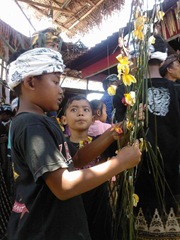
At the end, the coffin was taken from under the cloth, lifted on a multitude of shoulders and carried outside while the music of the gamelan went crescendo. The coffin was lifted to the top of the tower, using manpower only, and fixed with bands of cloth as secure as possible. The priest and a few men stayed on top of the tower, some 5 meters (17 feet) above the ground. Then the procession started moving. The mobile gamelan orchestra as well. The deceased paid a last visit to his village.
At important crossroads the tower was turned around a few times. The traffic came to a standstill. By turning the tower, and also the coffin around, one hopes to confuse the deceased, thus preventing him from finding his way back home to haunt the living.
The locals calmly wait in their vehicles. No sound of horns, no shouting. Tomorrow might be your Upacara. We were the last to join the procession that went in the direction of the graveyard. Contrary to the Balinese Hindus, Chinese inhabitants of Bali are not cremated but buried in graves covered with colorful tombstones.
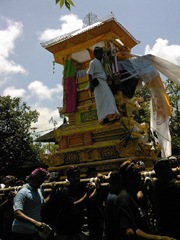
The statue of a big black bull was the first thing we saw once arrived at the cremation field.
The bull stood on a bamboo frame and the back was really a big lid that could be taken off.
A big group of men struggled to get the coffin out of the tower and into the bull. The lid was put back on. Fire was set to the decorated tower and the paper flowers, that had decorated the coffin, were thrown into the flames. I expected the bull to be put in the flames also. It did not happen that way.
Notwithstanding the heath, it was around noun, I felt a shiver when I noticed the gas canisters, partly hidden in the bushes some distance away from the bull…
Two thick hoses, that looked like brown snakes, ran from under the bushes to what seemed to be big high pressure cleaners. The sound of the music increased dramatically when the pressure cleaners suddenly spit fire. It were huge flame throwers. Time has not stood still in Bali and the traditional wood fires have been replaced by devices that make me think of dying people in bunkers on the Atlantic coastline and naked men with beards in Auschwitz.
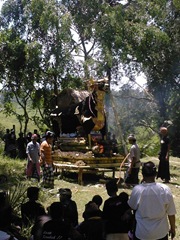
But of course I am a bulé, a white man with too much imagination and no eye for progress.
Ten years ago a cremation took three to four hours. Nowadays it is over in an hour or so.
Time is money, also in Bali, also in the cremation business. It was macabre.
The bull was gone in seconds and the color of the smoke changed constantly.
After a few minutes only the base, made of green coconut stems, remained. They were placed parallel with a space of around 70cm (2.5ft) between them. That is where the half burnt bones of the deceased ended up, the scorched skull clearly visible.
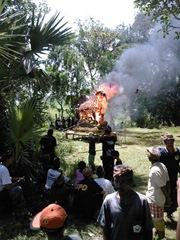
Willy didn’t see a thing. She was sitting on the ground, safely hidden behind the backs of the spectators. Shivering I presume. The ‘undertakers’, in this case two young men with a piece of cloth tied around their heads, against the blistering heath, put a piece of corrugated iron over the stems, thus creating an oven, open at both ends. They regularly poked in it with long bamboo poles and from time to time one of them lifted up the lid and peeked inside, his hand as a little roof above his eyes. I don’t want to think about what he was controlling in there.
When the gas was turned off, we said goodbye to the family. The ceremony would go on until late at night and part of the ashes would be scattered in the sea near Sanur. The rest would be kept in the house temple.
On the way back home, we told Willy that we also would like to be cremated. She looked at us in disbelief. ‘When my father would be cremated, I would jump after him in the flames!’ she said.
She didn’t know that, until the beginning of the 20th century, the wives of a king indeed jumped in the flames at their husband’s cremation.
he would like to work next weekend because he had Upacara (ceremony) this week and would like to have a day off. That day became two days in reality but that is not the point. Through Made, our pembantu (housekeeper), we learned that the ceremony Komang was referring to actually was the cremation of his grandfather who passed away last week, aged 87. I asked Komang if we could attend; it was no problem, on the contrary, we were welcome.
For us, foreigners, there is no specific dress code. The Balinese wear a sarong, women and men. We rented a car and left for Blahbatuh, the village where the cremation would take place. The driver stopped at a small crossing with an improvised traffic sign. ‘Hati hati, ada Upacara’, the sign said, ‘Attention, we have a ceremony’. From a distance we saw a high, colorful tower-like construction, further down the street. A lot of people dressed in white had gathered there. Komang, wearing traditional attire, was at the lookout for us and guided us through a narrow alley to the house where we
saw the coffin in a small, decorated pavilion. Chairs were brought and we each were given a bottle of Sprite and a piece of sweet bread. The coffin was covered with a white cloth and surrounded by offerings. My question about how the body could be kept at home at these temperatures was answered with one word: ‘Formol’. At the other side of the compound: the sound of traditional songs and recitations. A woman singing, a man reciting what seemed to be Balinese prayers. It sounded horrible and threatening. To me anyway. It made no impression whatsoever on the Balinese people in the compound. They strolled around, greeting people left and right, joking or smoking a cigarette. It looked like a reception rather than a funeral. After what seemed an eternity both was in fact just 45 minutes, the singing stopped and men started to demolish the railing of the pavilion with the coffin. A lot of people approached and were given flowering branches or offerings from the pavilion after which they left the compound, as in a procession, and positioned themselves in front of the colorful tower outside. It was a bizarre cortege, little children as well as elderly people with walking sticks, passed by carrying flowers or small braided baskets. I saw an important man with a ritual spear, held in front of him and other men with roasted ducks or piglets on a stick.
At the end, the coffin was taken from under the cloth, lifted on a multitude of shoulders and carried outside while the music of the gamelan went crescendo. The coffin was lifted to the top of the tower, using manpower only, and fixed with bands of cloth as secure as possible. The priest and a few men stayed on top of the tower, some 5 meters (17 feet) above the ground. Then the procession started moving. The mobile gamelan orchestra as well. The deceased paid a last visit to his village.
At important crossroads the tower was turned around a few times. The traffic came to a standstill. By turning the tower, and also the coffin around, one hopes to confuse the deceased, thus preventing him from finding his way back home to haunt the living.
The locals calmly wait in their vehicles. No sound of horns, no shouting. Tomorrow might be your Upacara. We were the last to join the procession that went in the direction of the graveyard. Contrary to the Balinese Hindus, Chinese inhabitants of Bali are not cremated but buried in graves covered with colorful tombstones.
The bull stood on a bamboo frame and the back was really a big lid that could be taken off.
A big group of men struggled to get the coffin out of the tower and into the bull. The lid was put back on. Fire was set to the decorated tower and the paper flowers, that had decorated the coffin, were thrown into the flames. I expected the bull to be put in the flames also. It did not happen that way.
Notwithstanding the heath, it was around noun, I felt a shiver when I noticed the gas canisters, partly hidden in the bushes some distance away from the bull…
Two thick hoses, that looked like brown snakes, ran from under the bushes to what seemed to be big high pressure cleaners. The sound of the music increased dramatically when the pressure cleaners suddenly spit fire. It were huge flame throwers. Time has not stood still in Bali and the traditional wood fires have been replaced by devices that make me think of dying people in bunkers on the Atlantic coastline and naked men with beards in Auschwitz.
But of course I am a bulé, a white man with too much imagination and no eye for progress.
Ten years ago a cremation took three to four hours. Nowadays it is over in an hour or so.
Time is money, also in Bali, also in the cremation business. It was macabre.
The bull was gone in seconds and the color of the smoke changed constantly.
After a few minutes only the base, made of green coconut stems, remained. They were placed parallel with a space of around 70cm (2.5ft) between them. That is where the half burnt bones of the deceased ended up, the scorched skull clearly visible.
When the gas was turned off, we said goodbye to the family. The ceremony would go on until late at night and part of the ashes would be scattered in the sea near Sanur. The rest would be kept in the house temple.
On the way back home, we told Willy that we also would like to be cremated. She looked at us in disbelief. ‘When my father would be cremated, I would jump after him in the flames!’ she said.
She didn’t know that, until the beginning of the 20th century, the wives of a king indeed jumped in the flames at their husband’s cremation.
Rabu, 20 Oktober 2010
My Honeymoon in Canggu Bali
Bali is Island of the God, Bali is one of 17,500 islands in the Indonesian archipelago, a extraordinary blend of relaxing informality and memorable savour on the life.
Canggu is a newly virgin tourism area in Bali. Canggu is small village on the beach about 20 minutes north of Seminyak half way to Tanah Lot. However, you can walk along the beach line of Kuta and Seminyak to the north direction and you will find this good looking spot. Canggu is widely refer to a large coastal stretch running from the village of Berawa north to Cemagi.
Canggu is a captivating village blessed with a rural landscape of verdant rice terraces that broadens to a stretch of coastline with a legendary surf break. Canggu is an antique fishermen village boasting one of the most untouched beaches on the southwest coast of Bali, back to the traditional Bali and outside from the hustle and bustle of international tourism. It is a peaceful area where travellers can breaking away the squeezes of modern living, but still be close enough to delight shopping and dining out in neighbouring Seminyak.
As just about all villas in Canggu bask either ricefield views, river gorge, ocean views, and absolute beachfronts. In most of the cases, beach is approachable on foot. Famed for its postcard quality sunsets and Canggu beach is blessed with one of the World’s best wave tunnels appropriate for skilled surfers then with all those perfect situation, we will have no trouble to savor our moments there.
Senin, 18 Oktober 2010
Bali beach hotel and golf
Join us to discover the real Bali
Join us to discover the real Bali.
We can also arrange your special itineraries or tour request. We are proud to provide you with experienced and informative English, German, Italian, Korean or Japanese speaking tour guides to be your personal assistance in Bali.
Rabu, 13 Oktober 2010
Ngaben
Ngaben
Ngaben or the Cremation Ceremony is the ritual performed to send the dead through the transition to his next life. The village Kul Kul, hanging in the tower of the village temple, will sound a certain beat to announce the departure of the deceased. The body of the deceased will be placed at Bale Delod, as if he were sleeping, and the family will continue to treat him as if he were still alive yet sleeping. No tears are shed, for he is only gone temporarily and he will reincarnate into the family.The Priest consults the Dewasa to determine the proper day for the ceremony. On the day of the ceremony, the body of the deceased is placed inside a coffin which is then placed inside a sarcophagus in the form of a buffalo (called Lembu) or a temple structure called Wadah made of paper and light wood. The Wadah will be carried to the village cremation site in a procession.The climax of Ngaben is the burning of the Wadah, using fire originating from a holy source. The deceased is sent to his afterlife, to be reincarnated in the future.
Ngaben
Ngaben
Ngaben or the Cremation Ceremony is the ritual performed to send the dead through the transition to his next life. The village Kul Kul, hanging in the tower of the village temple, will sound a certain beat to announce the departure of the deceased. The body of the deceased will be placed at Bale Delod, as if he were sleeping, and the family will continue to treat him as if he were still alive yet sleeping. No tears are shed, for he is only gone temporarily and he will reincarnate into the family.The Priest consults the Dewasa to determine the proper day for the ceremony. On the day of the ceremony, the body of the deceased is placed inside a coffin which is then placed inside a sarcophagus in the form of a buffalo (called Lembu) or a temple structure called Wadah made of paper and light wood. The Wadah will be carried to the village cremation site in a procession.The climax of Ngaben is the burning of the Wadah, using fire originating from a holy source. The deceased is sent to his afterlife, to be reincarnated in the future.
Perang Pandan
Tenganan is one of Bali’s original pre-Hindu settlements; a unique, 700-year-old village, hidden in the hills three kilometres north of Candi Dasa in East Bali. Here, the 300 residents – the Bali Aga people – practise a time-honoured lifestyle based around ritual and ceremony, bound by strict ‘adat’ (customary law) practices to maintain purity. The mekare-kare is an annual theatrical fight between the young men of the village, utilising prickly pandanus leaf whips! Each dual is staged to the intense martial sounds of ‘gamelan selonding’
music, and lasts only a few seconds, accompanied by much merriment and laughter. The attacks are warded off with tightly woven ‘ata’ vine shields; there are no winners and no losers because the objective is to draw blood as an offering to the gods. After the battles, the combatants’ wounds are treated with a stinging mixture of alcohol and turmeric, leaving no scars.
During festivals such as this, the women of the village wear the famous hand-woven double ikat textiles, known as ‘Geringsing’. Tenganan is the only place in Indonesia where this double weaving technique is practised and the ritually significant, magic cloth haas the power to protect the wearer from sickness and evil vibrations. On the first day of the mekare-kare, the unmarried maidens of the village ride creaky wooden ferris wheels, which are manually operated by the men. The turning symbolises the descent of the sun to the earth. Mekare-kare takes place in Tenganan every year in June or July as part of the Usaba Sambah festival. Visitors, however, are welcomed to the fortress-like village at anytime of year during daylight hours; many of the houses function as shops and workshops where expert craftsmen and women perform their centuries-old skills. This living museum is well worth a visit!
Perang Pandan
Tenganan is one of Bali’s original pre-Hindu settlements; a unique, 700-year-old village, hidden in the hills three kilometres north of Candi Dasa in East Bali. Here, the 300 residents – the Bali Aga people – practise a time-honoured lifestyle based around ritual and ceremony, bound by strict ‘adat’ (customary law) practices to maintain purity. The mekare-kare is an annual theatrical fight between the young men of the village, utilising prickly pandanus leaf whips! Each dual is staged to the intense martial sounds of ‘gamelan selonding’
music, and lasts only a few seconds, accompanied by much merriment and laughter. The attacks are warded off with tightly woven ‘ata’ vine shields; there are no winners and no losers because the objective is to draw blood as an offering to the gods. After the battles, the combatants’ wounds are treated with a stinging mixture of alcohol and turmeric, leaving no scars.
During festivals such as this, the women of the village wear the famous hand-woven double ikat textiles, known as ‘Geringsing’. Tenganan is the only place in Indonesia where this double weaving technique is practised and the ritually significant, magic cloth haas the power to protect the wearer from sickness and evil vibrations. On the first day of the mekare-kare, the unmarried maidens of the village ride creaky wooden ferris wheels, which are manually operated by the men. The turning symbolises the descent of the sun to the earth. Mekare-kare takes place in Tenganan every year in June or July as part of the Usaba Sambah festival. Visitors, however, are welcomed to the fortress-like village at anytime of year during daylight hours; many of the houses function as shops and workshops where expert craftsmen and women perform their centuries-old skills. This living museum is well worth a visit!
Langganan:
Postingan (Atom)